
 🆘 Worried about trouble abroad? Travel AI Rescue helps you on the spot — theft, illness, a lost passport, scams & more. See how it works →
 Will I Be Able to Get Around Japan With a Wheelchair or Mobility Device?
Short answer
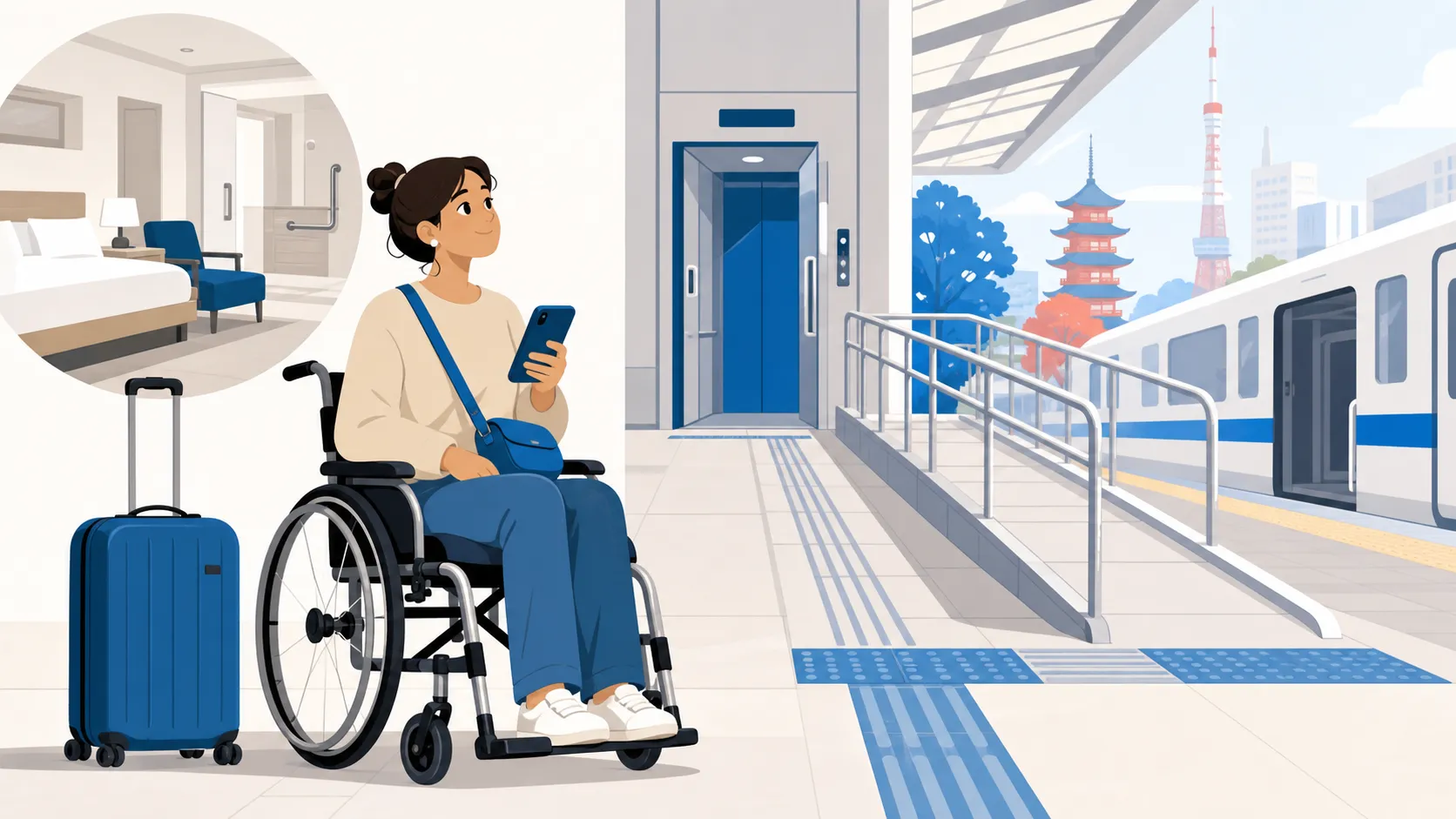
Most major JR and metro stations in Japan are step-free with elevators, but not every station is — especially smaller rural ones — so checking the specific stations on your route matters. JR East now lets you request platform assistance online up to noon two days before travel, and wheelchair-accessible hotel rooms exist but are limited in number, so book those far ahead.
If this is happening now
- If you’re at a station right now and need help, approach any station staff member (not just the gate) — they will escort you to the platform and help you board/alight.
- If you haven’t requested assistance in advance and staff seem unavailable, ask at the manned ticket gate (not an unstaffed automated one) — most stations keep at least one staffed gate.
- If your hotel room isn’t actually accessible despite being booked as such, ask the front desk immediately for a room change or nearby accessible alternative — don’t wait until check-out to raise it.
Who this applies to
Any nationality visiting Japan who uses a wheelchair, mobility scooter, walker, or has other mobility needs, traveling via JR/private rail, subway, or long-distance bus, for any trip length.
Decision table
| Situation | Status | What to do |
|---|---|---|
| Traveling on major JR/metro lines in large cities with advance staff assistance requested | Normal | Arrive a little early, go to the staffed gate, and staff will escort you to the platform |
| Traveling to smaller regional or rural stations without confirming accessibility | Needs action | Check the specific station’s barrier-free status before booking that leg of the trip |
| Wheelchair dimensions exceed standard train allowances (over ~120cm length/height or ~70cm width) | Needs action | Contact the rail operator in advance to confirm boarding is possible for your specific device |
| No staff available at an unstaffed station, or an elevator is out of service with no alternative offered | Emergency (time-sensitive) | Call the rail operator’s assistance line (e.g., JR East Infoline) or ask any staff member for an alternate route immediately |
Japan-specific procedure
Japan Railways (JR East) offers a formal barrier-free assistance system: passengers can apply online through services tied to “JRE Odekake Support” up to noon two days before travel, avoiding the need to arrange everything in person at the station. Even without advance booking, approaching any station staff member on the day works — staff will escort you to the platform and assist boarding and alighting, though arriving a bit early is recommended since coordinating the escort can take time.
Wheelchair size limits for boarding trains are commonly cited as roughly 120 cm in length/height and 70 cm in width — if your device is a larger mobility scooter or non-folding power wheelchair, contact the operator ahead of time to confirm it can be accommodated on your specific train type. JR East has also piloted reservable wheelchair-accessible seating on select limited express services (for example, the Narita Express and Shonan-Shinjuku Line) bookable through the Eki-net reservation platform — useful if you want a guaranteed accessible seat rather than relying on open space in a regular car.
Station-level accessibility (elevators, ramps, accessible restrooms, lowered ticket counters with tactile buttons) is extensive at major hub stations in Tokyo, Osaka, Kyoto, and other large cities, but coverage is not universal — some older or rural stations still lack elevators or have partial step-free access only on certain platforms. Before finalizing an itinerary that includes smaller stations, check that specific station’s accessibility page or call the operator directly, since a missing elevator partway through a route can force a significant detour.
For accommodation, wheelchair-accessible hotel rooms exist in Japan but are a small fraction of total inventory, particularly in older properties and smaller cities — book these as early as possible and confirm details directly with the hotel (door widths, roll-in shower vs. tub, bed height) rather than relying only on a listing’s “accessible” tag, since standards vary between properties.
What this is not
This is not the same as general “elevator available somewhere in the building” — some stations have an elevator that only connects certain platforms or exits, not full step-free access end-to-end, so “has an elevator” and “fully barrier-free” are not always identical. It’s also not the same as guaranteed same-day walk-up assistance at every station — very small unstaffed stations may have no one available without advance notice.
Recovery after a mistake
If you arrive at a station and discover it isn’t step-free as expected, ask staff for the nearest accessible alternate route or exit, or call the rail operator’s assistance line for guidance rerouting your trip. If your hotel room doesn’t match what was booked, ask for an immediate room change and, if none is available, request the hotel arrange an accessible room at a partner property for the night while pursuing a refund or adjustment for the mismatch. Keep photos and booking confirmations in case you need to dispute the charge later.
Questions travelers ask
How far in advance should I request station assistance? JR East’s online request system allows booking up to noon two days before travel; for smaller or rural stations, more notice is safer.
Are all Shinkansen (bullet train) stations wheelchair accessible? Major Shinkansen stations generally have strong accessibility, but always confirm the specific station and platform, especially for transfers between lines.
Can I bring my own mobility scooter on trains? Usually yes within standard size limits, but larger or heavier scooters should be confirmed with the operator in advance since car space and ramps vary by train type.
Do accessible hotel rooms cost more in Japan? Not necessarily more expensive, but they are limited in number and book out faster — reserve well ahead of your trip, especially in smaller cities.
What if an elevator is broken when I arrive at a station? Ask any staff member immediately — they can arrange an alternate route, a manual lift assist, or direct you to a nearby accessible entrance.
If this actually happens to you (Travel AI Rescue)
Navigating an unexpected accessibility gap — a broken elevator, an unstaffed gate, a mismatched hotel room — is stressful when you’re far from home. Travel AI Rescue keeps practical, source-checked guidance ready even without a strong signal.
| Free AI (ChatGPT, Gemini, etc.) | Travel AI Rescue |
|---|---|
| Can’t open it with no signal | A SIM problem is exactly when you have no signal — offline setup steps and emergency cards still work |
| You have to explain your situation every time | Already knows your plan and destination from your order — no re-explaining |
| Wrong answers in an emergency can be dangerous | SIM check uses a pre-approved decision tree; emergency numbers, embassies, and clinics come from official sources — never invented |
| No help before or after the trip | Pre-trip vault through automatic post-incident document generation (police report draft, insurance claim summary), end to end |
Included with every eSIM as standard ($7.40 if bought on its own). AI-drafted guidance, not a final medical/legal/immigration determination — contact local police, ambulance, or your embassy first in a real emergency.
Sources (checked 2026-07-20)
- JR-EAST: Accessibility — Travel Service Centers & Accessibility
- Essential Japan: JR East to expand wheelchair assistance services
Update trigger: Re-check if JR East or other operators change advance-request deadlines, wheelchair size limits, or expand reservable accessible seating to more train lines.
Related pages:
- Food, Accommodation & Accessibility hub
- Food Allergies in Japan: Cross-Contact, Dashi and Emergency Help
- Japan Attractions That Need Advance Booking: Avoid Fake Resellers
🆘 Don't just read it — be ready for it.
Travel AI Rescue is an emergency travel AI for theft, illness, SIM trouble & more — auto-drafted police reports, local-language cards and an on-device valuables vault. Bundle it with your eSIM.
See how Travel AI Rescue works →