
 🆘 Worried about trouble abroad? Travel AI Rescue helps you on the spot — theft, illness, a lost passport, scams & more. See how it works →
 The ground is shaking (or a tsunami warning just sounded) — what do I do right now?
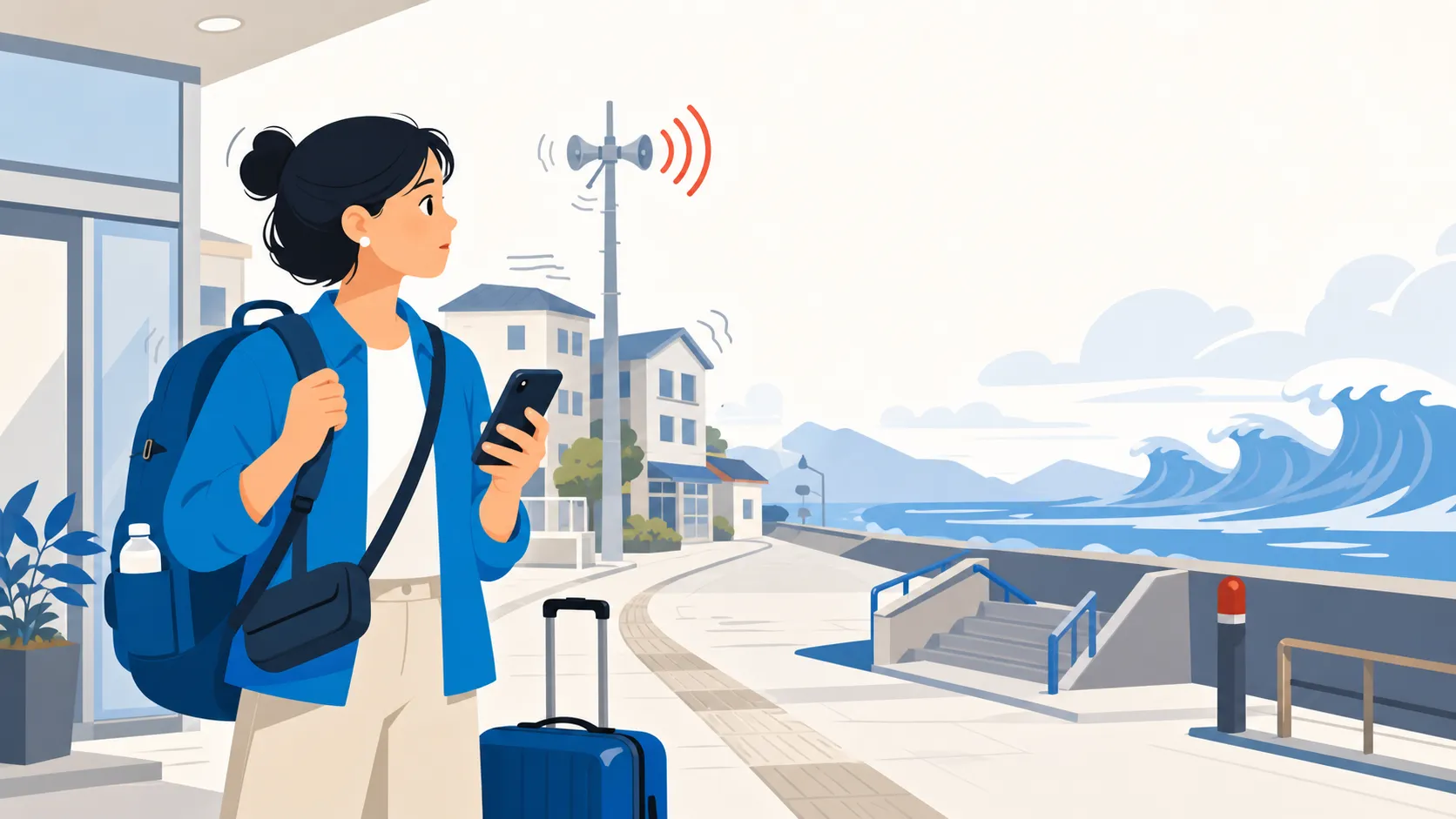
Short answer: If you feel shaking, protect yourself immediately — drop, take cover under sturdy furniture, and hold on until it stops. If you’re near the coast and shaking is strong or a tsunami warning is issued, move to high ground or a designated evacuation area on foot as soon as shaking stops — do not wait for official confirmation before evacuating from a coastal or low-lying area. Get information afterward, not before acting.
If this is happening now
- Protect your body first. Drop to the ground, get under a sturdy table or desk, cover your head and neck, and hold on until the shaking fully stops. If outdoors, move away from buildings, walls, and power lines. If on a train, hold on to a strap or rail and follow crew instructions — trains will typically stop automatically or slow down during a quake.
- If you’re near the coast or in a low-lying area, evacuate to higher ground immediately once shaking stops — do not wait for a siren or official tsunami warning to be confirmed before moving; large quakes near the coast are themselves the warning. Follow evacuation signs (blue-and-white tsunami evacuation signage) or hotel/staff instructions toward designated high ground or a tsunami evacuation building.
- Only after you are safe, check official information: the Safety Tips app, NHK World Japan, or ask hotel/station staff, to confirm whether a tsunami warning is in effect and whether it’s safe to return.
Who this applies to
Any nationality, anywhere in Japan, whether you’re indoors, outdoors, on a train, or near the coast. This guide assumes you’re currently traveling in Japan and may not have local disaster knowledge or a Japanese-language phone setup — the steps below are designed to work with visual cues and app alerts rather than requiring fluent Japanese.
Decision table
| Situation | Status | What to do |
|---|---|---|
| Light shaking, brief, no warnings issued | Normal | Note it and continue, but stay aware — check if it’s part of a larger sequence |
| Moderate-to-strong shaking, no coastal exposure | Needs action | Drop-cover-hold during shaking; after it stops, check for hazards (fallen objects, gas smell) before moving around |
| Strong shaking while near the coast, or any tsunami warning/advisory issued | Emergency | Evacuate to high ground or a tsunami evacuation building immediately, on foot, without waiting for confirmation |
| Earthquake Early Warning (EEW) alert sounds on your phone/TV before shaking starts | Needs action | You may have a few seconds: drop and take cover immediately, don’t run outside |
| You’re unsure if it’s over, or aftershocks continue | Needs action | Stay in a safe position/location; expect aftershocks and avoid damaged structures |
Japan-specific procedure
Japan’s Earthquake Early Warning (EEW) system, run by the Japan Meteorological Agency (JMA), detects the initial P-wave of an earthquake and can broadcast an alert — via phone, TV, and public speakers — a few seconds to tens of seconds before the stronger shaking (S-wave) arrives. That warning window is short, so the response is always the same: drop, cover, and hold on immediately, wherever you are.
For tsunami risk specifically: JMA issues tsunami warnings and advisories based on quake location, magnitude, and depth. Because the wave can arrive within minutes of a coastal or undersea quake, official guidance in Japan is that people in coastal areas should evacuate to high ground on their own initiative as soon as strong shaking occurs, rather than waiting to hear a siren or check an app — the shaking itself is the signal to move.
Practical situational guidance:
- In a train: trains are designed to detect quakes and slow or stop automatically; stay seated or braced, hold on, and follow crew announcements — do not force doors open or try to exit onto the tracks yourself.
- In a hotel: get under a table or into a doorframe-free interior space away from windows and heavy furniture; do not use elevators during or immediately after a quake; follow posted evacuation routes once shaking stops.
- In a coastal or low-lying tourist area (beaches, waterfront districts, some castle towns near rivers): identify the nearest tsunami evacuation sign or high ground before you need it, if possible, and move there immediately after strong shaking, even without an official warning yet confirmed.
For real-time, multilingual information, two resources are widely recommended for travelers:
-
The “Safety tips” app (JNTO-linked), which pushes earthquake, tsunami, and weather alerts in multiple languages, includes an evacuation flowchart, and offers helpful phrases for communicating with people around you during a disaster.
-
NHK World-Japan, Japan’s international public broadcaster, which provides tsunami and earthquake information in English and other languages during major events.
-
Japan Meteorological Agency, Earthquake Early Warning: https://www.jma.go.jp/jma/en/Activities/eew.html
-
JNTO, Safety tips for travelers app: https://www.jnto.go.jp/safety-tips/eng/app.html
-
NHK World-Japan (for disaster broadcasts in English): search “NHK World Japan” for the live news portal
What this is not
This is not the same as general severe-weather itinerary planning (typhoons, heat, heavy rain), which is a slower-moving decision about whether to change travel plans — see the companion article on typhoon/heat/rain itinerary decisions. Earthquake and tsunami response is about immediate physical safety in the first seconds and minutes; weather disruption is about planning around forecasted, several-hours-to-days-out risk.
Recovery after a mistake
If you freeze or don’t react during the shaking itself, that’s normal — as soon as you’re aware again, get low and take cover if shaking continues, or check your surroundings for hazards (broken glass, unstable furniture, gas smell) if it has stopped. If you evacuated to high ground and it turns out there was no tsunami warning, that is not a wasted trip — Japanese guidance explicitly encourages erring on the side of evacuating for coastal quakes, and there is no penalty for returning once an “all clear” is confirmed through official channels (Safety Tips app, NHK World, or local authorities).
Questions travelers ask
Do I need to download an app before my trip, or can I do it during an emergency? Download the Safety Tips app before you travel if possible — during an actual emergency, focus on physical safety first, not your phone.
What if I don’t understand the announcement on a train or in a station? Watch what staff and other passengers do — evacuation behavior is usually visible even across a language barrier, and station staff in major cities increasingly have basic English or use translation tools.
Are hotels required to have evacuation plans for guests? Japanese hotels generally post evacuation routes and emergency information in guest rooms; check this on arrival as a habit, especially in coastal or older buildings.
How common are major earthquakes during a typical visit? Small, unnoticeable tremors are common across Japan; major damaging quakes are comparatively rare during any single trip, but the country’s preparedness culture means alerts and drills happen more visibly than in many other destinations.
If this actually happens to you (Travel AI Rescue)
In the middle of a real quake or tsunami warning, the hard part isn’t just knowing the rule — it’s getting clear, offline-capable guidance fast when you’re disoriented in an unfamiliar place, which is exactly what Travel AI Rescue is built to support alongside official alerts.
| Free AI (ChatGPT, Gemini, etc.) | Travel AI Rescue |
|---|---|
| Can’t open it with no signal | A SIM problem is exactly when you have no signal — offline setup steps and emergency cards still work |
| You have to explain your situation every time | Already knows your plan and destination from your order — no re-explaining |
| Wrong answers in an emergency can be dangerous | SIM check uses a pre-approved decision tree; emergency numbers, embassies, and clinics come from official sources — never invented |
| No help before or after the trip | Pre-trip vault through automatic post-incident document generation (police report draft, insurance claim summary), end to end |
Included with every eSIM as standard ($7.40 if bought on its own). AI-drafted guidance is a supplement to, never a replacement for, official disaster alerts and instructions from local authorities — always follow JMA warnings, local evacuation orders, and staff instructions first.
Sources (checked 2026-07-20)
- Japan Meteorological Agency, “Japan’s Earthquake Early Warning system”: https://www.jma.go.jp/jma/en/Activities/eew.html
- JNTO, “Safety tips for travelers”: https://www.jnto.go.jp/safety-tips/eng/app.html
- NHK World-Japan (disaster/tsunami English-language coverage)
Update trigger: Re-check after any major seismic event affecting Japan, or if JMA/JNTO update alert systems or app recommendations.
Related pages: Health & Emergencies hub, Emergency Numbers in Japan: 110, 119 and the Visitor Hotline, Typhoon, Extreme Heat or Heavy Rain: Change Your Japan Itinerary?
🆘 Don't just read it — be ready for it.
Travel AI Rescue is an emergency travel AI for theft, illness, SIM trouble & more — auto-drafted police reports, local-language cards and an on-device valuables vault. Bundle it with your eSIM.
See how Travel AI Rescue works →