
 🆘 Worried about trouble abroad? Travel AI Rescue helps you on the spot — theft, illness, a lost passport, scams & more. See how it works →
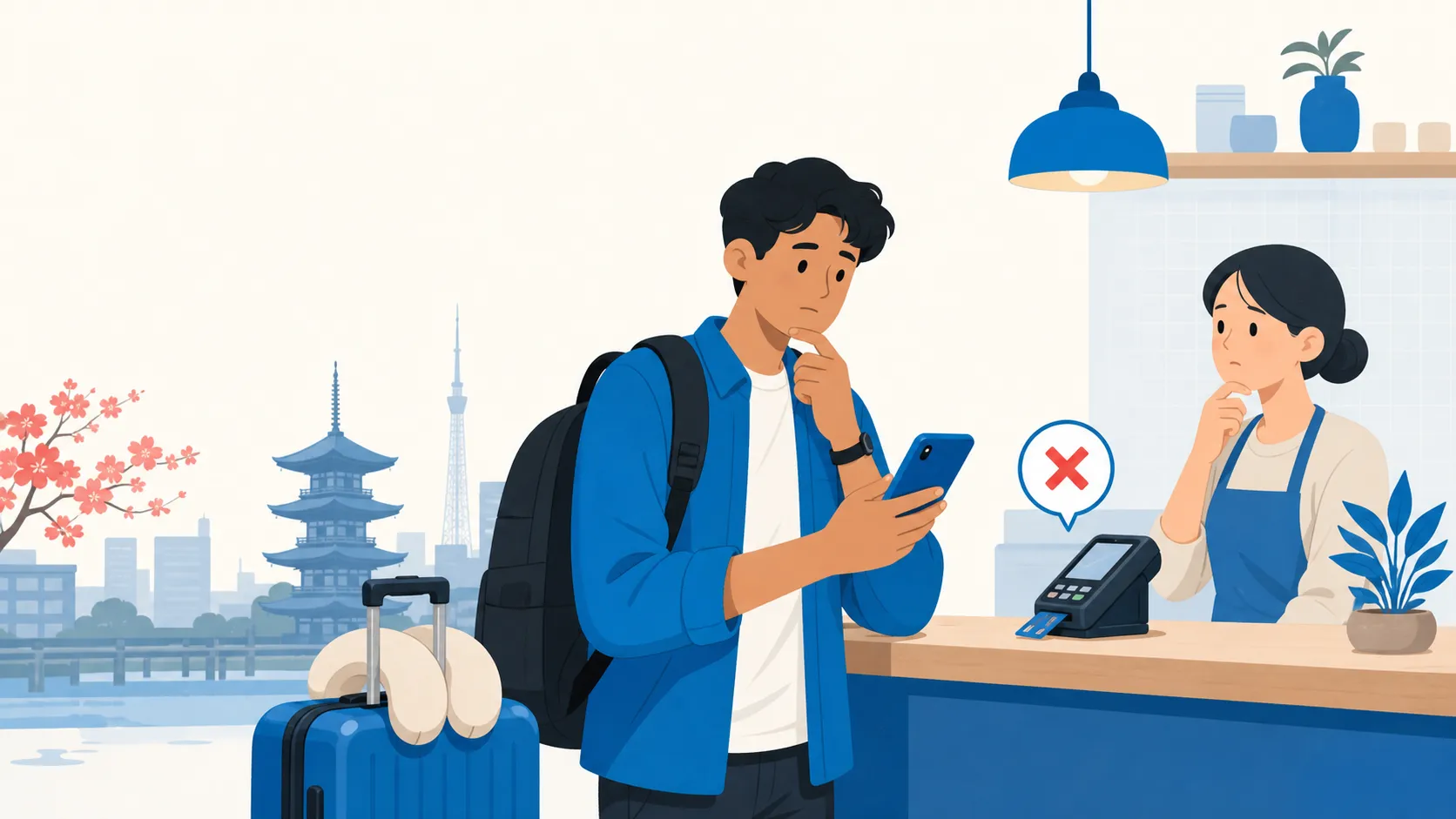
 My Card Was “Declined” in Japan — But Is It Really?
Short answer: What looks like a decline is often one of three different things: a genuine block, a temporary authorization hold (money looks gone but isn’t actually charged yet), or a dynamic currency conversion (DCC) prompt asking if you want to pay in your home currency instead of yen — always say no to that. Check which one it is before assuming your card failed.
If this is happening now
- Look at the terminal screen before panicking: if it’s asking “Pay in JPY or [your home currency]?”, that’s DCC, not a decline — choose Japanese yen (JPY).
- If the terminal shows an error and rejects the card outright, try tapping (contactless) instead of inserting, or try a second card — many blocks are card-specific, not universal.
- If it’s still rejected, pay with cash or an IC card for now, then contact your card issuer via their app or the number on the back of your card to check for a fraud hold.
Who this applies to
This applies to any visitor to Japan using a foreign-issued credit or debit card, regardless of nationality or visa type, whether you’re shopping, dining, or withdrawing cash from an ATM. It assumes you’re relying on your home bank’s card and app support, not a Japanese bank account, and doesn’t assume you already have travel insurance or a backup card set up.
Normal, needs action, or emergency
| Situation | What it looks like | What to do |
|---|---|---|
| Normal | Card works, receipt shows the yen amount you expected | No action needed |
| Needs action | Terminal asks you to choose a currency, or a “pending” charge appears higher/lower than expected | Choose JPY; if a hold looks wrong, ask the merchant for a receipt and check with your bank once online |
| Emergency | Card is rejected everywhere, you have no cash and no other card | Use an IC card balance or 7-Eleven ATM cash for immediate needs, then call your issuer’s international collect number |
Telling the three problems apart (confirmed 2026-07-20)
Dynamic currency conversion (DCC): In Japan, many card terminals and some ATMs offer to charge you in your home currency instead of yen. It looks like a normal transaction screen, not an error, but choosing your home currency typically adds a 3–5% conversion markup on top of any foreign transaction fee your card already charges. Always select yen/local currency when given the choice. Reference: Visa — decoding dynamic currency conversion.
Authorization hold: Hotels, car rentals, and some gas stations place a temporary hold (an estimated or deposit amount) on your card that isn’t a final charge. This can make your available balance look lower or show as a separate “pending” line, which some travelers mistake for being overcharged or declined on a later purchase. Holds usually clear within a few days to two weeks depending on your bank.
Genuine decline: This is an actual rejection at the terminal, usually caused by your bank’s fraud system flagging an unfamiliar country, a card network mismatch (some networks like Discover or Diners route through partner networks such as JCB or UnionPay in Japan and aren’t accepted everywhere Visa/Mastercard are), or a terminal expecting PIN entry your card isn’t set up for. Foreign cards in Japan are typically read as signature-based rather than requiring a PIN, so this is less common than in some other countries, but it still happens.
What this is not
A decline is not the same as your card being lost, stolen, or maxed out — most Japan-side declines are precautionary bank behavior, not a sign anything is wrong with your account. It’s also not the same as a merchant simply not accepting your card type at all (see our guide on where cash and cards work in Japan) — that’s an acceptance issue, not a decline.
Recovery after a mistake
If you accidentally accepted a DCC charge in your home currency, you can still dispute the exchange margin with your card issuer, though the merchant transaction itself typically can’t be reversed — ask the merchant to redo it in yen if you notice before leaving the counter. If a hold hasn’t cleared after two weeks, contact your bank directly with the merchant name and date; most holds auto-release even without you calling, but banks can sometimes force an early release. If you believe you were actually declined for fraud-prevention reasons, use your bank’s travel notification feature (via app) so the same purchase can go through on retry.
Questions travelers ask
Should I notify my bank before traveling to Japan? Many banks no longer require this, but checking your app for a “travel notice” feature takes a minute and can reduce false declines.
Why did my card work at one 7-Eleven but not another? ATM software and card network support can vary slightly by terminal age; if one Seven Bank ATM rejects your card, try another nearby one before assuming your card has a problem.
Is it normal for a hotel to hold more than my nightly rate? Yes — many hotels place holds covering incidentals or a security deposit; this is standard practice and not a sign of an error.
Can I use Apple Pay/Google Pay to avoid these issues? Digital wallets often bypass DCC prompts and can reduce terminal compatibility issues, but they still rely on your underlying card network working in Japan.
If this actually happens to you (Travel AI Rescue)
A card problem at the register is stressful precisely because you have to decide fast, in a language you may not read. Travel AI Rescue is designed to walk you through exactly this kind of moment.
| Free AI (ChatGPT, Gemini, etc.) | Travel AI Rescue |
|---|---|
| Can’t open it with no signal | A SIM problem is exactly when you have no signal — offline setup steps and emergency cards still work |
| You have to explain your situation every time | Already knows your plan and destination from your order — no re-explaining |
| Wrong answers in an emergency can be dangerous | SIM check uses a pre-approved decision tree; emergency numbers, embassies, and clinics come from official sources — never invented |
| No help before or after the trip | Pre-trip vault through automatic post-incident document generation (police report draft, insurance claim summary), end to end |
Included with every eSIM as standard ($7.40 if bought on its own). AI-drafted guidance, not a final medical/legal/immigration determination — contact local police, ambulance, or your embassy first in a real emergency.
Sources (checked 2026-07-20)
- Visa — Decoding Dynamic Currency Conversion
- LoyaltyLobby — DCC attempt in Japan
- Bankrate — Say no to DCC
Update trigger: Re-check if Japanese payment terminals change DCC default behavior, or if major card networks alter foreign-card acceptance rules in Japan.
Related pages: Money & Connectivity hub · Does Japan still require cash? · Fake booking and support messages
🆘 Don't just read it — be ready for it.
Travel AI Rescue is an emergency travel AI for theft, illness, SIM trouble & more — auto-drafted police reports, local-language cards and an on-device valuables vault. Bundle it with your eSIM.
See how Travel AI Rescue works →