 🆘 Worried about trouble abroad? Travel AI Rescue helps you on the spot — theft, illness, a lost passport, scams & more. See how it works →
 Can I Bring My Prescription Medicine into Japan Without It Being Confiscated?
Short answer: Usually yes, within quantity limits, and without extra paperwork for most everyday prescriptions. But Japan restricts or bans certain active ingredients — including some stimulant-type medications and pseudoephedrine-based cold remedies — regardless of whether they’re legal or prescribed at home. Bringing more than the personal-use limit, or a controlled substance, requires an import certificate obtained before you leave.
If this is happening now
- Check your medicine’s active ingredient against Japan’s restricted list before packing — not just the brand name, since the same drug may have a different name in Japan.
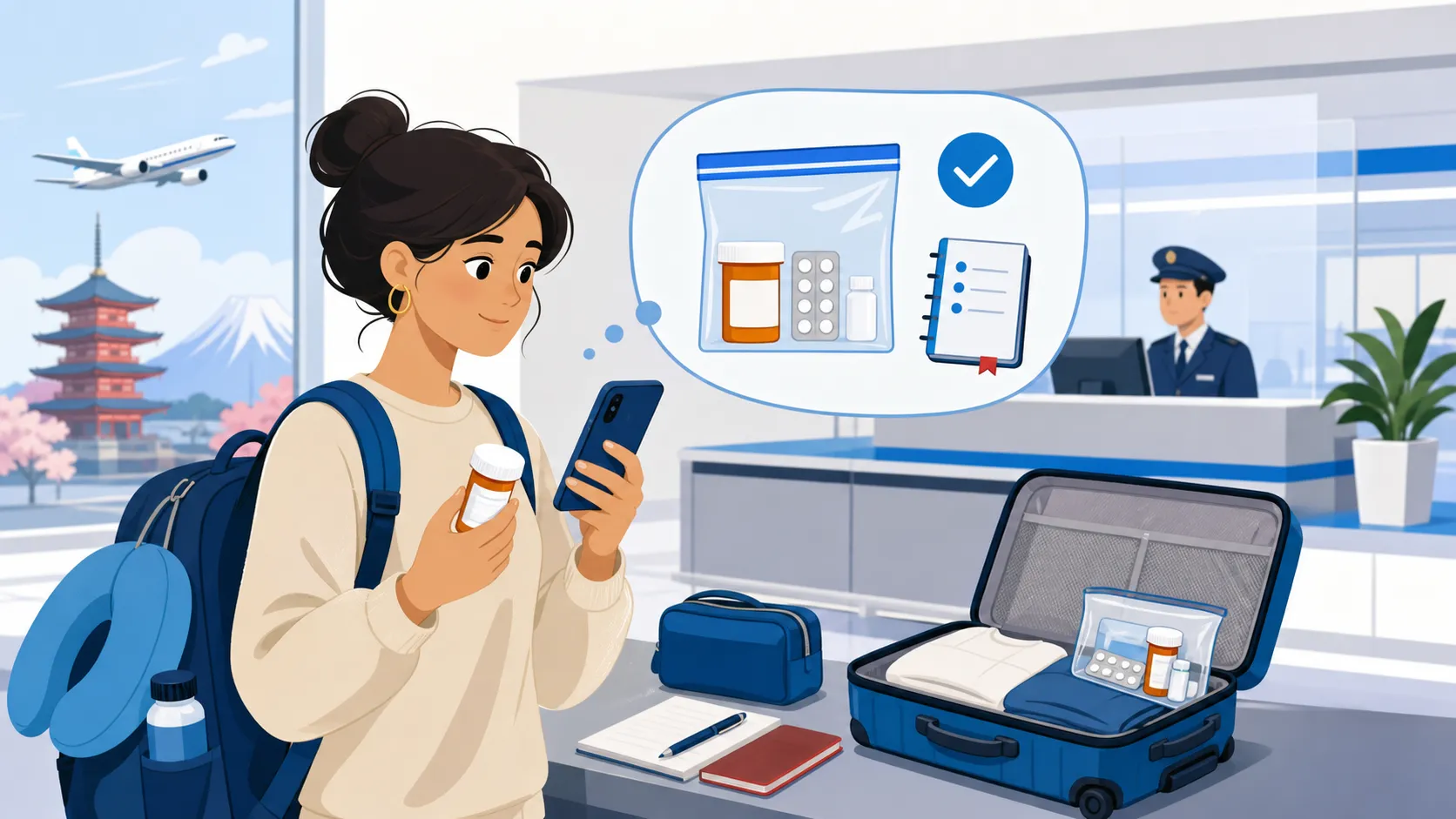
- If you’re within personal-use quantity limits and the ingredient isn’t restricted, pack it in original labeled packaging with your prescription — no advance permit is needed.
- If you’re carrying a large supply, an injectable/syringe kit, or anything containing a narcotic or “stimulant raw material,” apply for the correct certificate — an Import Confirmation (Yunyu Kakunin-sho, formerly called Yakkan Shoumei) or, for narcotics, permission from Japan’s Narcotics Control Department — before you travel. There is no such thing as arranging this after you land.
Who this applies to
This applies to any visitor of any nationality bringing personal medication into Japan for their own use, regardless of where the prescription was issued — a US, EU, Australian, or any other country’s prescription is treated the same way by Japanese customs. It does not assume Japanese insurance, a Japanese prescription, or Japanese residency. Quantity limits and restricted-ingredient rules apply identically to short-term tourists and longer-term visitors.
Decision table
| Situation | Status | What to do |
|---|---|---|
| Common prescription (e.g., blood pressure, cholesterol, most antidepressants) within monthly-supply limits | Normal | Carry in original packaging with prescription copy; no certificate needed |
| Injectable medication with syringes (e.g., insulin), pre-filled or self-injection kit, up to 1 month’s supply | Normal | Carry with prescription; declare at customs if asked |
| Supply exceeding limits (over ~1–2 months depending on drug type) | Needs action | Apply for Import Confirmation before departure |
| Medicine containing pseudoephedrine or other “stimulant raw materials,” or ADHD medications like Adderall/Vyvanse | Needs action | Contact MHLW or Japan’s Narcotics Control Department before travel — some require special permission, some are effectively banned for personal import |
| You arrive without required paperwork for a restricted substance | Emergency | Declare it to customs immediately rather than concealing it — see Recovery below |
Japan-specific procedure (verified 2026-07-20)
Japan’s Ministry of Health, Labour and Welfare (MHLW) sets personal-import quantity limits below which no Import Confirmation is required:
- Poisons, deadly poisons, and prescription drugs: up to a 1-month supply
- External-use drugs (creams, patches, etc.): up to 24 units per item
- Injectable drugs and syringes (pre-filled syringes / self-injection kits only): up to a 1-month supply
- Other drugs and quasi-drugs: up to a 2-month supply
- Cosmetics: up to 24 units per item
- Disposable contact lenses: up to a 2-month supply
Above those amounts, you must apply for an Import Confirmation (輸入確認書, Yunyu Kakunin-sho) — the certificate long known informally as “Yakkan Shoumei” — before leaving home, and present it to the customs officer on arrival. Applications can now be filed online.
Narcotics (e.g., morphine, fentanyl) and “Stimulants’ Raw Materials” (e.g., lisdexamfetamine, the active ingredient in Vyvanse) are strictly prohibited to import without prior written permission from the Regional Bureau of Health and Welfare, obtained before departure — not something arranged at the airport. Certain pseudoephedrine-based cold and allergy medicines (common brands like Sudafed/Actifed in some countries) fall into similarly restricted categories in Japan because the ingredient can be diverted to make illicit stimulants; treat these as high-risk and confirm status before packing, even with a valid home prescription.
Official links:
- MHLW: Information for those bringing medicines for personal use into Japan: https://www.mhlw.go.jp/stf/seisakunitsuite/bunya/kenkou_iryou/iyakuhin/kojinyunyu/topics/tp010401-1_00001.html
- Online Import Confirmation application: https://impconf.mhlw.go.jp/aicpte/page/login.jsp?lang=en/
- Narcotics Control Department (narcotics/stimulant raw material applications): https://www.ncd.mhlw.go.jp/en/application2.html
- MHLW contact: yakkan@mhlw.go.jp (drugs/cosmetics/devices) or fax +81-3-3501-0034 (narcotics/stimulants)
What this is not
An Import Confirmation for medicine is not the same as a general customs declaration. Every traveler files a customs declaration on arrival regardless of what they’re carrying (see the companion customs guide), but that everyday form does not grant permission to bring in a restricted drug — the medicine-specific certificate is a separate approval that, for controlled categories, must be secured before you ever board your flight.
Recovery after a mistake
- If you realize mid-trip that your medicine is restricted and you didn’t get a permit: do not try to obtain one from inside Japan for the same trip — declare the situation to customs or immigration proactively rather than risk concealment being discovered, and contact your embassy for guidance.
- If your medicine was confiscated on arrival: ask for a written record of what was seized, and contact your country’s embassy in Japan and your home prescriber to arrange an alternative (an equivalent Japanese medication via a local doctor is sometimes the fastest path).
- If you’re unsure before departure and have time: email
yakkan@mhlw.go.jpwith the drug’s active ingredient (not just the brand name) and quantity — MHLW responds to individual inquiries.
Questions travelers ask
Can I bring my regular prescription pills to Japan? Almost always yes, in reasonable quantities, in original packaging with your prescription — most common medications need no special permit.
Is Adderall legal to bring into Japan? No — Adderall’s amphetamine-based ingredients fall under Japan’s tightly controlled “stimulant” category and are generally not permitted for personal import without special, hard-to-obtain authorization. Many travelers switch to an alternative medication before their trip after checking with their prescriber.
What about Sudafed or other pseudoephedrine cold medicine? Treat it as high-risk. Some pseudoephedrine-containing products are restricted or effectively banned for personal import — check the specific product before packing, even with a doctor’s note.
Do I need a permit for my insulin and needles? Usually not, if you’re within the 1-month-supply limit for pre-filled syringes or a self-injection kit — carry your prescription and original packaging.
What happens if I don’t declare a medicine I wasn’t sure about? Undeclared restricted substances found at customs can lead to confiscation and, in serious cases, legal consequences — when in doubt, declare it and let the customs officer make the call.
If this actually happens to you (Travel AI Rescue)
Medication questions often turn urgent fast — a confiscated prescription with no backup plan is a real problem days into a trip, and that’s exactly the kind of situation Travel AI Rescue is designed to help you navigate.
| Free AI (ChatGPT, Gemini, etc.) | Travel AI Rescue |
|---|---|
| Can’t open it with no signal | A SIM problem is exactly when you have no signal — offline setup steps and emergency cards still work |
| You have to explain your situation every time | Already knows your plan and destination from your order — no re-explaining |
| Wrong answers in an emergency can be dangerous | SIM check uses a pre-approved decision tree; emergency numbers, embassies, and clinics come from official sources — never invented |
| No help before or after the trip | Pre-trip vault through automatic post-incident document generation (police report draft, insurance claim summary), end to end |
Included with every eSIM as standard ($7.40 if bought on its own). AI-drafted guidance, not a final medical/legal/immigration determination — contact local police, ambulance, or your embassy first in a real emergency.
Sources
- MHLW — Information for those bringing medicines for personal use into Japan — checked 2026-07-20
- Narcotics Control Department — application information — checked 2026-07-20
Update trigger: Re-verify if MHLW changes quantity thresholds, adds/removes restricted ingredients, or updates the online Import Confirmation system.
Related pages:
- Entry & Documents hub
- Japan Customs: Food, CBD, Vapes and Items to Declare
- Is Visit Japan Web Official and Is It Required?
🆘 Don't just read it — be ready for it.
Travel AI Rescue is an emergency travel AI for theft, illness, SIM trouble & more — auto-drafted police reports, local-language cards and an on-device valuables vault. Bundle it with your eSIM.
See how Travel AI Rescue works →