
 🆘 Worried about trouble abroad? Travel AI Rescue helps you on the spot — theft, illness, a lost passport, scams & more. See how it works →
 Why Do I Still Need Cash If My Card Works Fine at the Hotel?
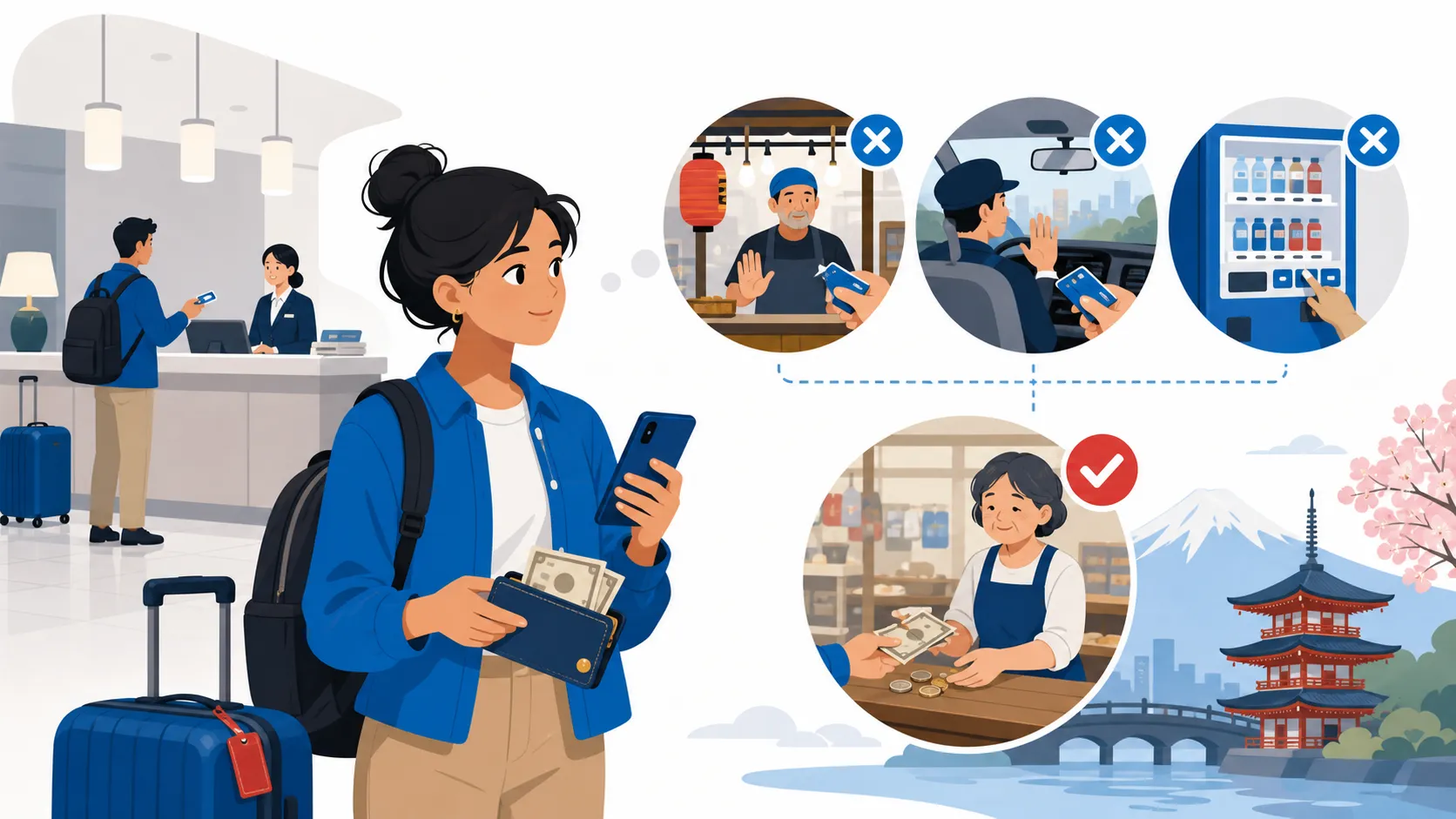
Short answer: Cards and IC cards (Suica, Pasmo, ICOCA) now cover most of a Japan trip — trains, convenience stores, chain restaurants, big shops. But small izakaya, local markets, shrine/temple fees, some ryokan, and rural buses still often expect cash. Carry ¥10,000–¥20,000 in cash as a buffer and load an IC card for transit and everyday taps.
If this is happening now
- If a shop or vending machine won’t take your card, ask “IC card wa tsukaemasu ka?” or just tap a Suica/Pasmo/ICOCA — most accept it even where cards fail.
- No IC card and no cash on hand: use a 7-Eleven (Seven Bank) ATM — nearly every store has one, open 24 hours, and it accepts foreign Visa, Mastercard, Maestro, UnionPay, and Amex.
- Still stuck: Japan Post Bank ATMs also take major international cards, but only during post office hours (roughly 9:00–18:00 on weekdays, shorter on weekends).
Who this applies to
This applies to any traveler visiting Japan on a tourist or short-term visa, regardless of nationality, arriving by air or sea, for any trip length. It assumes you’re using a personal foreign-issued debit or credit card and/or cash, not a Japanese bank account. It does not assume you have Japanese residency, a local bank card, or travel insurance already arranged.
Normal, needs action, or emergency
| Situation | What it looks like | What to do |
|---|---|---|
| Normal | Cards work at hotels, department stores, chain restaurants, train stations | Keep a small cash reserve for exceptions |
| Needs action | A specific shop, stall, or small restaurant is cash-only | Use a nearby 7-Eleven or Japan Post ATM before you need to pay |
| Emergency | No cash, no working card, and you need to pay for something now (transport, food, medicine) | Go to the nearest convenience store ATM first; if the card itself is blocked, see the card-decline steps below and contact your issuer while you still have a working IC card balance for transit |
Getting and using an IC card in Japan (confirmed 2026-07-20)
IC cards (Suica, Pasmo, ICOCA, and similar regional cards) work interchangeably on trains, buses, and at IC-compatible registers nationwide, including vending machines and convenience stores.
- Welcome Suica: a tourist-only card issued by JR East, available at JR East Travel Service Centers at Haneda and Narita airports. It’s valid for 28 days and currently costs ¥1,500 (loaded onto the card, issuing fee waived). Details: JR East Welcome Suica.
- Tourist Pasmo: launched 20 May 2026, available at Narita (Keisei Terminal 1/2 stations) and Haneda (Keikyu Terminal 1/2 and Terminal 3 stations). Details: Pasmo official site.
- Welcome Suica Mobile App: works on iPhone 8 and later, valid 180 days — useful if you don’t want a physical card.
- Regular (non-tourist) Suica and Pasmo cards returned to normal sale in stores as of March 2025 after a prior chip shortage, so unnamed cards are generally available again at ticket machines.
Foreign-card ATMs that actually work (confirmed 2026-07-20)
- Seven Bank ATMs (inside 7-Eleven, ~21,000 locations): 24 hours, accepts Visa, Mastercard, Maestro, UnionPay, Amex, Diners; fee ¥110–¥220 per withdrawal; up to ¥50,000 per transaction; menus in 13 languages. Official: Seven Bank international cards.
- Japan Post Bank ATMs: at post offices and some stations, Visa/Mastercard/Maestro/Cirrus/Plus; free during regular hours, ¥110 outside them; up to ¥100,000 per transaction. Availability is tied to post office hours, not 24/7.
What this is not
This is not the same problem as a card being declined. If your card is inserted or tapped and actively rejected with an error, that’s a separate issue — see our card decline and DCC guide. This page is about payment availability (does this place take cards or IC at all), not about your card failing when it should otherwise work.
Recovery after a mistake
If you loaded too little onto an IC card and it’s rejected at a gate, most stations have a “fare adjustment” (seisan) machine near the exit — top up there rather than at the entry gate. If you paid cash but got shortchanged or overcharged, ask for a receipt (reshiito) at the register; most Japanese retailers correct errors immediately when asked politely. If an ATM keeps your card, contact the bank listed on the ATM (Seven Bank or Japan Post Bank both have on-site help numbers) before assuming it’s lost.
Questions travelers ask
Do taxis in Japan take cards? Most city taxis and app-based rides (like GO) accept cards and IC cards; some smaller local operators are cash-only, so ask before the ride if unsure.
Can I use Apple Pay or Google Pay Suica instead of a physical card? Yes, if your phone and card network support it — it works the same as a physical IC card at gates and registers.
Will my home IC card top-up work at all stations? IC cards work nationwide, but region-specific discount fares don’t cross networks — the balance itself is universal.
Is ¥20,000 enough cash for a week in Tokyo? For a mixed cash/card trip, that’s a reasonable buffer for meals, shrines, and small shops — you can always add more from a 7-Eleven ATM.
If this actually happens to you (Travel AI Rescue)
Payment and connectivity problems in Japan tend to show up at the worst moment — mid-transaction, with a line behind you. Travel AI Rescue is built for exactly that kind of on-the-spot situation.
| Free AI (ChatGPT, Gemini, etc.) | Travel AI Rescue |
|---|---|
| Can’t open it with no signal | A SIM problem is exactly when you have no signal — offline setup steps and emergency cards still work |
| You have to explain your situation every time | Already knows your plan and destination from your order — no re-explaining |
| Wrong answers in an emergency can be dangerous | SIM check uses a pre-approved decision tree; emergency numbers, embassies, and clinics come from official sources — never invented |
| No help before or after the trip | Pre-trip vault through automatic post-incident document generation (police report draft, insurance claim summary), end to end |
Included with every eSIM as standard ($7.40 if bought on its own). AI-drafted guidance, not a final medical/legal/immigration determination — contact local police, ambulance, or your embassy first in a real emergency.
Sources (checked 2026-07-20)
- Seven Bank — ATMs for overseas cards
- JR East — Welcome Suica
- Pasmo official site
- Japan Guide — ATMs in Japan
Update trigger: Re-check if Welcome Suica/Tourist Pasmo pricing, issue locations, or IC card chip supply changes, or if Seven Bank/Japan Post Bank fee schedules are revised.
Related pages: Money & Connectivity hub · Card declined, DCC and holds · eSIM not working in Japan
🆘 Don't just read it — be ready for it.
Travel AI Rescue is an emergency travel AI for theft, illness, SIM trouble & more — auto-drafted police reports, local-language cards and an on-device valuables vault. Bundle it with your eSIM.
See how Travel AI Rescue works →