
 🆘 Worried about trouble abroad? Travel AI Rescue helps you on the spot — theft, illness, a lost passport, scams & more. See how it works →
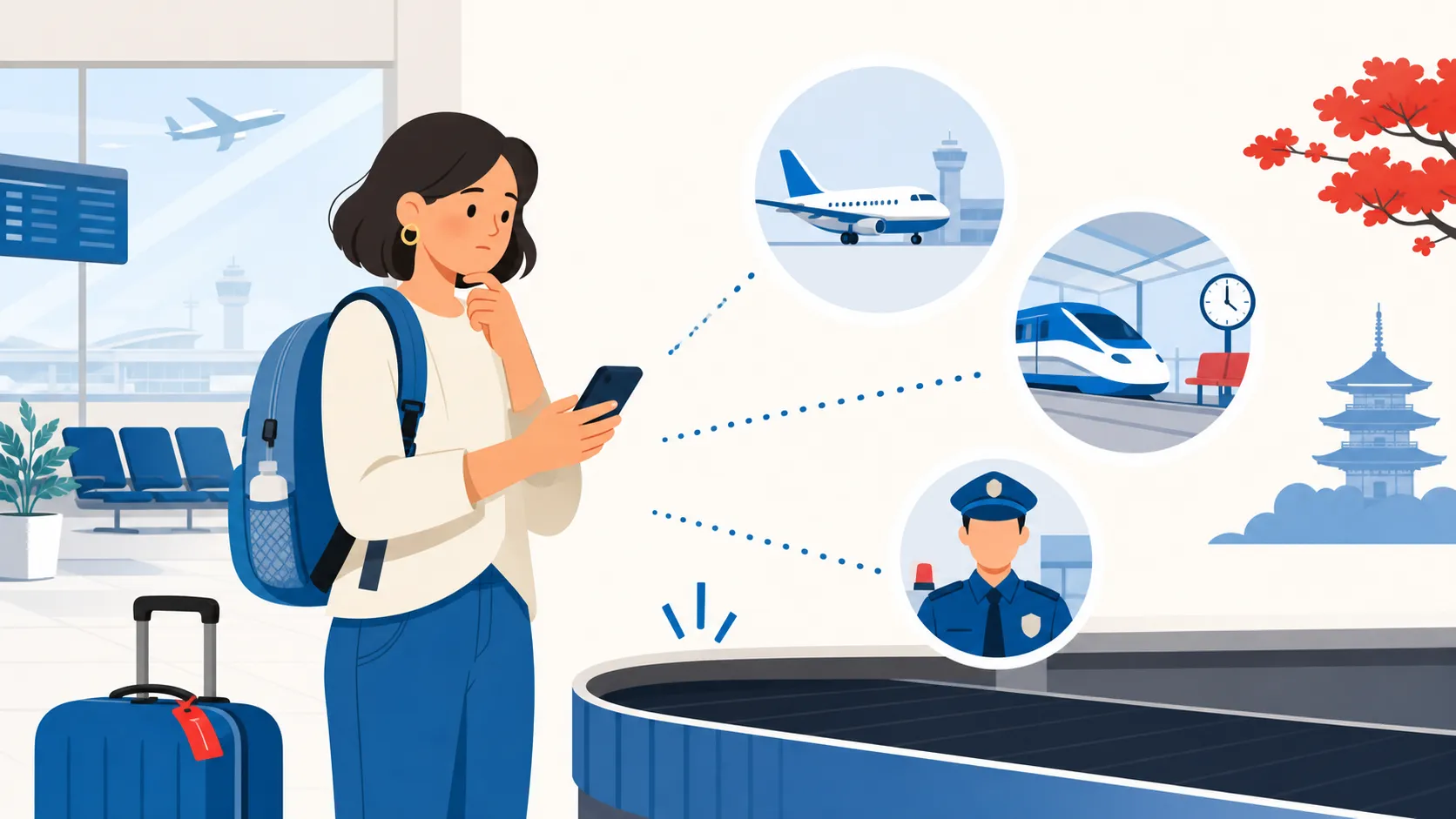
 My bag is missing in Japan — should I call the airline, the train station, or the police?
Short answer: It depends on where you last had custody. Airline checked baggage that never appeared on the carousel is the airline’s Property Irregularity Report (PIR) process. A bag left on a train, in a station, or in a taxi goes through that operator’s lost-and-found, then to police after about a week. An item stolen or lost on the street goes straight to the local koban (police box).
If this is happening now
- Identify where you last definitely had the bag: airport carousel (airline), train/platform/taxi (transport operator), or street/shop (police/koban).
- Go to that specific desk immediately — airline baggage services counter before leaving the airport, or the station office/koban nearest to where you noticed it missing.
- Get a reference number (PIR number for airlines, a claim tag for trains, or a police report number) before you leave — without it, follow-up by phone is much harder.
Who this applies to
Any nationality, any purpose of visit, arriving by air or moving domestically by train, bus, or taxi in Japan. The right first contact depends on custody, not on your visa status or nationality.
Decision table
| Situation | Status | First contact |
|---|---|---|
| Checked bag didn’t arrive at baggage claim | Needs action | Airline baggage service desk at the arrival airport — file a PIR before leaving |
| You realize a bag is missing after leaving the airport (within 21 days of travel) | Needs action | Airline’s online missing baggage form, or call their baggage service line |
| Item left on a JR/private train, platform, or in a taxi | Needs action | Station staff or that train line’s lost-and-found office (or taxi company if you have the receipt) |
| More than about a week has passed since a train/station loss | Needs action | Contact the police lost property center — items move there after the railway’s holding period |
| Item lost on the street, in a park, or stolen from your bag | Needs action | Nearest koban (police box) — file a lost property or theft report |
| Passport, credit cards, or large cash amounts are missing along with your bag | Emergency | Report to police first, then contact your embassy/consulate and cancel cards immediately |
Japan-specific procedure
Airline baggage (airport custody). File a Property Irregularity Report at the baggage services counter before you leave the arrivals area — you’ll need your boarding pass, passport, and baggage claim tag. Airlines use the WorldTracer system to search globally. You typically have up to 21 days to file a claim if you notice damage or missing contents after leaving, per most carriers’ conditions of carriage; report as soon as possible either way. Check your airline’s baggage page directly (e.g., ANA’s baggage information page, JAL’s baggage accident page) for their specific process and contact numbers.
Train and station lost property. If you leave something on a JR train or in a station, contact station staff immediately or call the JR East Infoline (050-2016-1603, supporting English, Chinese, and Korean) — items found are first held at the local station, then moved to a central JR lost-and-found office where they’re generally kept for about a week. Tokyo Metro and other private railways run similar systems with their own contact lines. Under Japan’s Lost Property Act, an operator must hand unclaimed items to police within 7 days, so acting quickly matters — after that the item moves to the regional police lost-property center.
Koban and police lost property. For anything lost on the street, in a shop, or stolen, go to the koban nearest to where it happened. Staff will complete a lost property report and give you a reference number; found items — including those handed over from train stations — are typically held by police for about 3 months before disposal. Tokyo’s Metropolitan Police Department publishes an English lost-and-found portal explaining the process.
- JR East, lost items information: https://www.jreast.co.jp/en/info/lost.html
- Tokyo Metropolitan Police Department, Lost and Found: https://www.keishicho.metro.tokyo.lg.jp/multilingual/english/finding_services/lost_and_found/lost_found.html
- National Police Agency, lost property (street) portal: https://www.npa.go.jp/bureau/soumu/ishitsubutsu/otoshimono/en/lost-road.html
- ANA baggage information (damaged/missing/lost): https://www.ana.co.jp/en/us/travel-information/baggage-information/damage-lost/
What this is not
This is not the same as a delayed courier delivery (takuhaibin), where you already know the tracking number and the bag is simply still moving through Yamato or Sagawa’s network — see the companion article on luggage delivery timelines for that case. That situation is a delay, not a loss, and rarely needs police involvement.
Recovery after a mistake
If you filed at the wrong desk — for example, you went to the koban for an airline bag — don’t worry, just go to the correct counter next; Japanese lost-property systems are well organized and staff can usually point you to the right office. If you realize days later you should have acted sooner, file the report anyway: airlines still accept late claims within their stated window, and police lost-property centers hold items for months, so a delayed report is far better than none.
Questions travelers ask
Do I need to speak Japanese to file these reports? No — JR East’s Infoline supports English, Chinese, and Korean, major airlines have English-speaking baggage staff, and larger city koban often have some English support or can use a phone interpreter.
What if I don’t know exactly where I lost it? Start with the police lost-property system (via NPA’s portal or a koban) — they’re the terminal point for street losses and can search across their citywide database.
Will I be charged for delivery if my item is found? For station and police lost-and-found, you usually collect in person or arrange delivery at your own cost; airlines typically deliver recovered baggage to your address free of charge as part of their PIR process.
Should I still report if I think it’s unlikely to be found? Yes — Japan has an unusually high lost-item return rate, and a report also creates a paper trail useful for travel insurance claims.
If this actually happens to you (Travel AI Rescue)
Figuring out which of three different lost-property systems applies to your specific bag is exactly the kind of “which door do I knock on” question that eats time when you’re stressed — Travel AI Rescue can route you to the right one fast.
| Free AI (ChatGPT, Gemini, etc.) | Travel AI Rescue |
|---|---|
| Can’t open it with no signal | A SIM problem is exactly when you have no signal — offline setup steps and emergency cards still work |
| You have to explain your situation every time | Already knows your plan and destination from your order — no re-explaining |
| Wrong answers in an emergency can be dangerous | SIM check uses a pre-approved decision tree; emergency numbers, embassies, and clinics come from official sources — never invented |
| No help before or after the trip | Pre-trip vault through automatic post-incident document generation (police report draft, insurance claim summary), end to end |
Included with every eSIM as standard ($7.40 if bought on its own). AI-drafted guidance, not a final medical/legal/immigration determination — contact local police, ambulance, or your embassy first in a real emergency.
Sources (checked 2026-07-20)
- JR East, “About Lost Items”: https://www.jreast.co.jp/en/info/lost.html
- Tokyo Metropolitan Police Department, Lost and Found guide: https://www.keishicho.metro.tokyo.lg.jp/multilingual/english/finding_services/lost_and_found/lost_found.html
- National Police Agency, lost property portal: https://www.npa.go.jp/bureau/soumu/ishitsubutsu/otoshimono/en/lost-road.html
- ANA, Damaged/Missing/Lost baggage information: https://www.ana.co.jp/en/us/travel-information/baggage-information/damage-lost/
Update trigger: Re-check if JR East, Tokyo Metro, or major airlines change their contact numbers or retention periods.
Related pages: Trains & Luggage hub, Luggage Delivery in Japan: Deadlines, Delays and Tracking, Passport Lost in Japan: Embassy, Police and Flight Steps
🆘 Don't just read it — be ready for it.
Travel AI Rescue is an emergency travel AI for theft, illness, SIM trouble & more — auto-drafted police reports, local-language cards and an on-device valuables vault. Bundle it with your eSIM.
See how Travel AI Rescue works →