
 🆘 Worried about trouble abroad? Travel AI Rescue helps you on the spot — theft, illness, a lost passport, scams & more. See how it works →
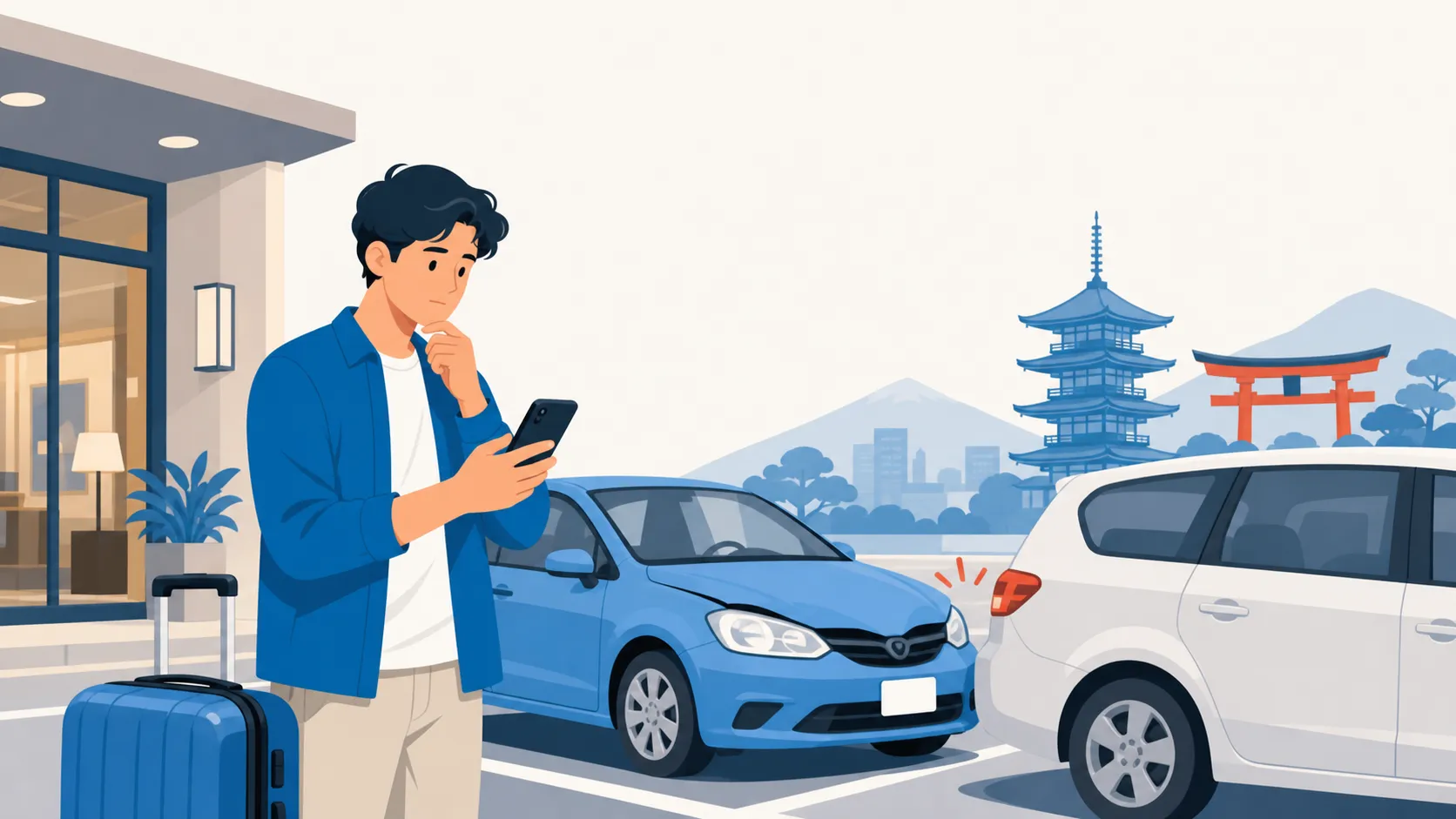
 I Was in a Rental Car Accident in Japan — What Do I Do Right Now?
Short answer
Call 110 (police) immediately, even for a minor fender-bender — Japanese insurance claims and rental company coverage almost always require an official police-reported accident. Then call your rental company’s emergency line. Ask about a Traffic Accident Certificate (交通事故証明書) and, if you need it for your home insurer, a Non-Operation Certificate (NOC) conversation with the rental company.
If this is happening now
- Check for injuries, move to safety if possible, and call 110 for police (and 119 if anyone is hurt) — do not just exchange information privately and drive off.
- Call the phone number on your rental agreement/dashboard sticker to notify the rental company; they will tell you where to take the car and what forms they need.
- Get the police report reference number and rental company incident number before you leave the scene — you’ll need both to request documents later.
Who this applies to
Any nationality driving a rental car in Japan on a valid IDP or accepted license translation, whether the accident is a collision with another vehicle, a pedestrian, a parked car, or solo (hitting a guardrail, pole, etc.), regardless of who is at fault.
Decision table
| Situation | Status | What to do |
|---|---|---|
| Very minor scrape, no injuries, other party agreeable, car still drivable | Needs action | Still call 110 to get an official report — Japanese insurers generally won’t pay out without one |
| Clear fault dispute or damage to third-party property/vehicle | Needs action | Call 110, do not admit fault at the scene, let police and insurers determine liability |
| Injuries to any party, however minor-seeming | Emergency | Call 110 and 119 immediately; do not move seriously injured people unless there’s immediate danger |
| Car undriveable, blocking traffic, or accident on an expressway | Emergency | Call 110, put on hazard lights, use a warning triangle if provided, move to the shoulder or behind a barrier if safe |
Japan-specific procedure
Japan requires drivers involved in a traffic accident to report it to police under the Road Traffic Act, and Japan’s Ministry of Land, Infrastructure, Transport and Tourism (MLIT) confirms that stopping, protecting the injured, and notifying police are the first legal duties after any accident. Skipping this step is not just a paperwork risk — it can also be treated as a hit-and-run-style violation.
After police attend or you report at a police station, the accident is registered with the Japan Safe Driving Center (JSDC), which is the body that issues the official Traffic Accident Certificate (交通事故証明書). This certificate is the only document that formally proves the accident happened and is generally required by both Japanese rental insurance and most home-country travel insurers before they’ll process a claim. You (or the rental company on your behalf) apply using a form available at police stations, koban, or JSDC offices; processing by mail commonly takes about a week or more, so request it as early as possible if you’re leaving Japan soon.
Separately, most Japanese rental contracts include a Non-Operation Charge (NOC) — a fixed fee (commonly in the range of roughly ¥20,000 for a drivable car and ¥50,000 for one that must be towed, though amounts vary by company) charged to cover the rental company’s lost business while the car is repaired or cleaned, regardless of fault. This is different from a “certificate of no-fault”; ask your rental company directly whether NOC applies to your case and whether your optional insurance/waiver covers it. If your home insurer specifically asks for a “non-fault certificate,” clarify with them exactly what document they mean, since Japanese practice centers on the police-issued accident certificate rather than a separate no-fault form.
What this is not
This is not the same as being pulled over for a traffic violation with no accident (speeding, parking) — that’s handled with an on-the-spot ticket process, not a police accident report or NOC. It’s also not the same as breakdown assistance for a mechanical failure with no collision; call your rental company’s road service line for that instead of 110.
Recovery after a mistake
If you left the scene without calling police because the damage looked trivial, contact the rental company as soon as possible and be honest about what happened — insurers may still be able to help if you report promptly, but delay makes it harder to get an official certificate later. If you already paid an NOC charge you think was miscalculated, ask the rental company in writing for an itemized explanation and, if unresolved, raise it with your credit card’s travel insurance or your home insurer using the rental agreement and any photos you took at the scene.
Questions travelers ask
Do I really need to call police for a tiny parking-lot scrape? Yes — without a police report, most rental insurance and travel insurance claims in Japan will be denied outright.
How long does it take to get the Traffic Accident Certificate? Applications by mail through the Japan Safe Driving Center commonly take about a week to ten days; ask the rental company if they can expedite or if a temporary confirmation number is enough for your insurer.
What is NOC and can I avoid it? NOC is a fixed operational-loss fee charged by the rental company after an accident, separate from repair costs; some premium insurance add-ons or credit card rental coverage reduce or waive it, so check before you decline extra insurance at pickup.
Who is considered at fault in Japan? Fault is usually assessed by police and insurers based on the accident circumstances, not decided at the roadside — don’t sign anything admitting fault before this process happens.
What if the other driver has no insurance? Report to police regardless; your rental company’s compulsory insurance and any personal travel insurance may still cover your side of the claim.
If this actually happens to you (Travel AI Rescue)
An accident abroad is disorienting, especially if you’re worried about language barriers with police or the rental counter. Travel AI Rescue is built for exactly this kind of on-the-ground moment.
| Free AI (ChatGPT, Gemini, etc.) | Travel AI Rescue |
|---|---|
| Can’t open it with no signal | A SIM problem is exactly when you have no signal — offline setup steps and emergency cards still work |
| You have to explain your situation every time | Already knows your plan and destination from your order — no re-explaining |
| Wrong answers in an emergency can be dangerous | SIM check uses a pre-approved decision tree; emergency numbers, embassies, and clinics come from official sources — never invented |
| No help before or after the trip | Pre-trip vault through automatic post-incident document generation (police report draft, insurance claim summary), end to end |
Included with every eSIM as standard ($7.40 if bought on its own). AI-drafted guidance, not a final medical/legal/immigration determination — contact local police, ambulance, or your embassy first in a real emergency.
Sources (checked 2026-07-20)
- MLIT Japan: What should you do first if you are in a traffic accident?
- Japan Safe Driving Center: Certification of Traffic Accidents
Update trigger: Re-check if JSDC changes certificate processing times/fees, or if a rental company’s NOC amounts or insurance waiver terms are updated for your travel dates.
Related pages:
- Driving & Street Mobility hub
- Can I Drive in Japan With My International Driving Permit?
- Bicycles and E-Scooters in Japan: Road Rules Visitors Miss
🆘 Don't just read it — be ready for it.
Travel AI Rescue is an emergency travel AI for theft, illness, SIM trouble & more — auto-drafted police reports, local-language cards and an on-device valuables vault. Bundle it with your eSIM.
See how Travel AI Rescue works →