
 🆘 Worried about trouble abroad? Travel AI Rescue helps you on the spot — theft, illness, a lost passport, scams & more. See how it works →
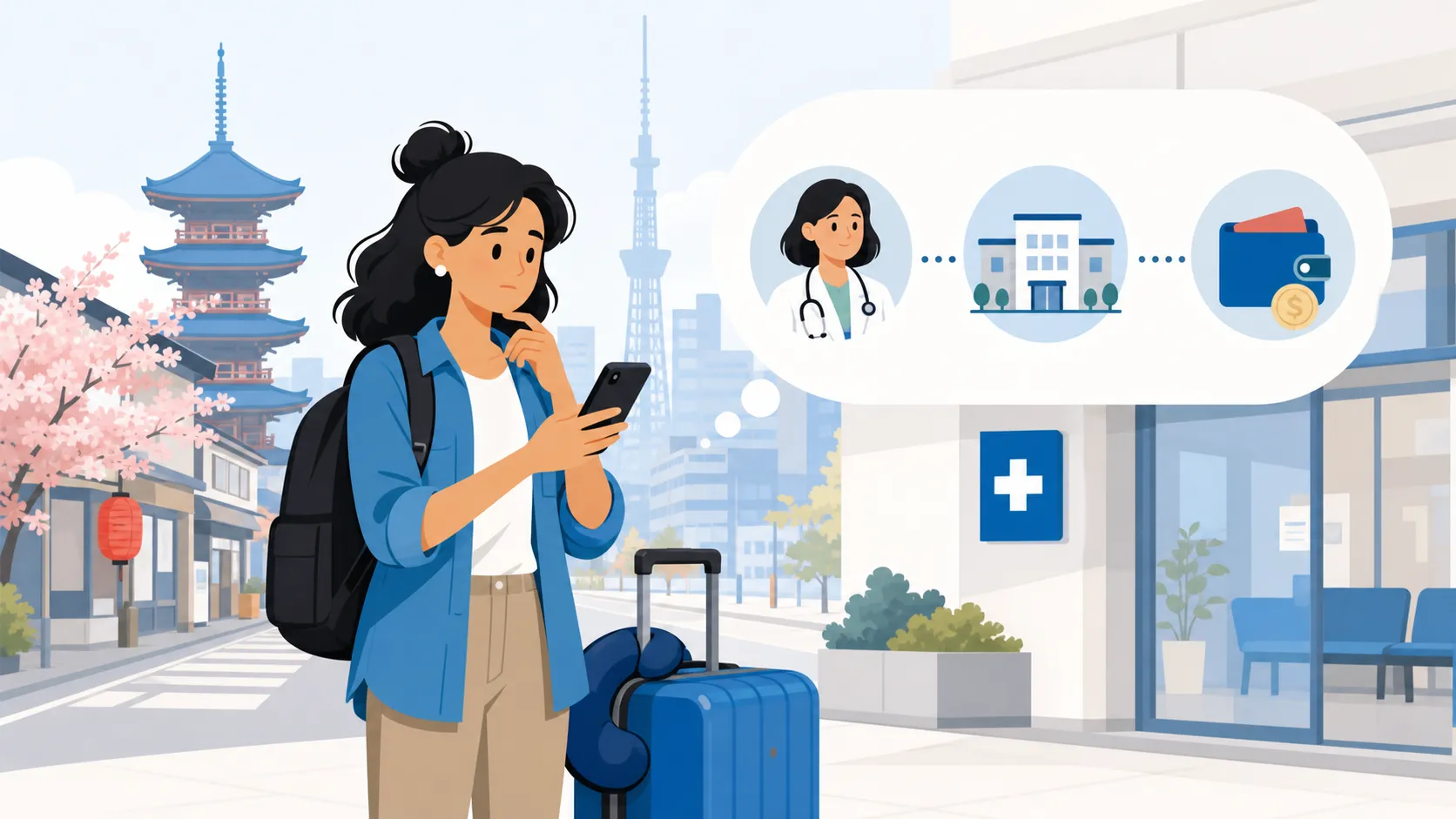
 I need to see a doctor in Japan — how do I find one and what will it cost?
Short answer: Without Japanese national health insurance, foreign visitors are generally expected to pay 100% of costs upfront, often in cash, at the time of treatment — travel insurance is what makes this affordable, either through direct billing or reimbursement afterward. English-speaking care exists but is concentrated in major cities; the AMDA International Medical Information Center and JNTO resources can help you find it.
If this is happening now
- If it’s a medical emergency (severe pain, breathing difficulty, major injury, loss of consciousness), call 119 for an ambulance — Japanese emergency hospitals treat patients regardless of insurance status, then bill afterward.
- If it’s not an emergency, call your travel insurance provider’s assistance line first (if you have one) — many can direct you to a partner clinic and arrange direct billing so you don’t pay in full upfront.
- If you have no insurance and no assistance line, find an English-speaking clinic or hospital through AMDA’s information service or a hotel concierge, and bring your passport and enough cash or a card for upfront payment.
Who this applies to
Any nationality visiting Japan for tourism, business, or short-term stays, without enrollment in Japan’s national health insurance system. This covers both travelers with private travel insurance and those without.
Decision table
| Situation | Status | What to do |
|---|---|---|
| Minor cold, mild symptoms | Normal | Visit a local pharmacy for over-the-counter medicine, or a walk-in clinic if it persists |
| Need a non-urgent doctor visit (ongoing prescription, minor injury) | Needs action | Call your travel insurance assistance line, or use AMDA/JNTO resources to find an English-speaking clinic; bring passport and insurance card/policy number |
| No travel insurance, need to see a doctor | Needs action | Confirm the clinic accepts cash/card payment upfront; ask for an itemized receipt (ryōshūsho) for any later reimbursement or record-keeping |
| Severe symptoms, injury, or you’re unsure if it’s an emergency | Emergency | Call 119 for an ambulance, or go directly to a hospital emergency department; payment is addressed after treatment |
| Chronic condition medication ran out or was lost | Needs action | See a doctor for a new prescription — don’t assume your home-country medication is available or legal to import without checking first |
Japan-specific procedure
Payment expectations. Japanese hospitals and clinics generally expect foreign tourists and short-term visitors without Japanese insurance to pay the full cost upfront, in cash — credit cards are accepted at some larger hospitals but not universally, and some facilities may ask for proof of ability to pay before non-emergency treatment. This is markedly different from Japanese residents, who pay roughly 30% of costs out of pocket under national health insurance while insurers cover the rest. In a genuine emergency, hospitals will treat you regardless of ability to pay immediately, but you will still be billed afterward — and unpaid medical bills can affect future entry to Japan, so settling bills (through insurance or otherwise) matters even after you’ve left.
Travel insurance role. If you have travel insurance with medical coverage, call the assistance/emergency line on your policy before or as soon as possible after seeking care — many providers can arrange direct billing with a partner hospital so you avoid paying the full amount out of pocket. If direct billing isn’t available, pay upfront, keep every itemized receipt (ryōshūsho, 領収書) and a copy of your diagnosis/treatment summary, and file for reimbursement once home.
Finding English-speaking care. The AMDA International Medical Information Center (a longstanding nonprofit resource) provides information on foreign-language-capable medical institutions and free telephone interpretation for medical visits, in English, Portuguese, Spanish, Chinese, Thai, and Korean — a valuable resource if a clinic’s front desk doesn’t speak your language. The Japan National Tourism Organization (JNTO) also publishes travel insurance and medical-access guidance for visitors, and many hotel concierges keep a list of nearby English-friendly clinics. In major cities (Tokyo, Osaka, Kyoto), international clinics and hospital international patient departments are more common; in smaller towns, options narrow and phone interpretation becomes more important.
What to bring to any appointment: your passport (required for identity and often for billing purposes), your travel insurance policy details/card if you have one, a list of any current medications (with generic names if possible, since brand names differ), and cash or a card for potential upfront payment.
- AMDA International Medical Information Center: http://eng.amda-imic.com/
- JNTO, Travel Insurance in Japan: https://www.japan.travel/en/plan/travel-insurance-in-japan/
- Japan Medical Association, medical portal for international patients: https://www.med.or.jp/people/foreigner/list_en.html
What this is not
This is not the same as an emergency dispatch call — if you need an ambulance or urgent care right now, call 119 directly rather than searching for an English-speaking clinic first; finding the “right” clinic can wait until after you’re safely being treated. It’s also not the same as consular medical assistance — embassies generally provide lists of local doctors but do not pay medical bills or provide treatment themselves.
Recovery after a mistake
If you paid upfront without insurance and later realize you do have coverage (through a credit card’s travel benefits, for example), keep every receipt and diagnosis document — most reimbursement claims can be filed after the fact as long as you have an itemized bill. If you went to a clinic that turned out not to have English support and communication broke down, call AMDA’s information line for phone interpretation support, or ask the clinic if they can arrange a video interpretation service — many larger hospitals now have one on hand.
Questions travelers ask
Will a hospital refuse to treat me if I can’t pay immediately? In a genuine emergency, no — Japanese hospitals are expected to treat emergency patients regardless of ability to pay upfront, though you will be billed afterward; for non-emergency visits, some clinics may ask about payment ability before treatment.
Do I need to speak Japanese to see a doctor? Not necessarily — international clinics and larger city hospitals often have English-speaking staff or interpretation services; AMDA’s phone interpretation service can help bridge the gap elsewhere.
Can I bring prescription medication from home? Some common medications are restricted or require special import permission (yakkan shoumei) in Japan — check Japan’s Ministry of Health, Labour and Welfare guidance before traveling if you take regular prescription medication, rather than assuming it’s fine to bring.
Is dental care handled the same way? Yes, the same upfront-payment expectation generally applies to dental clinics for visitors without Japanese insurance.
What if I need ongoing treatment after I return home? Ask the treating doctor for a written summary (in English if possible) of diagnosis and treatment to hand to your doctor at home, and keep all receipts for insurance claims.
If this actually happens to you (Travel AI Rescue)
Finding a clinic that can actually communicate with you, in the middle of feeling unwell in an unfamiliar country, is exactly the kind of practical routing problem Travel AI Rescue is built to help with, alongside official resources like AMDA.
| Free AI (ChatGPT, Gemini, etc.) | Travel AI Rescue |
|---|---|
| Can’t open it with no signal | A SIM problem is exactly when you have no signal — offline setup steps and emergency cards still work |
| You have to explain your situation every time | Already knows your plan and destination from your order — no re-explaining |
| Wrong answers in an emergency can be dangerous | SIM check uses a pre-approved decision tree; emergency numbers, embassies, and clinics come from official sources — never invented |
| No help before or after the trip | Pre-trip vault through automatic post-incident document generation (police report draft, insurance claim summary), end to end |
Included with every eSIM as standard ($7.40 if bought on its own). AI-drafted guidance is not a medical determination and cannot diagnose or treat you — contact local emergency services or a licensed medical professional for any actual health concern.
Sources (checked 2026-07-20)
- AMDA International Medical Information Center: http://eng.amda-imic.com/
- JNTO, “Travel Insurance in Japan”: https://www.japan.travel/en/plan/travel-insurance-in-japan/
- Japan Medical Association, medical portal for foreign patients: https://www.med.or.jp/people/foreigner/list_en.html
Update trigger: Re-check if AMDA’s contact details change, or if JNTO updates its insurance/medical access guidance for visitors.
Related pages: Health & Emergencies hub, Emergency Numbers in Japan: 110, 119 and the Visitor Hotline, Typhoon, Extreme Heat or Heavy Rain: Change Your Japan Itinerary?
🆘 Don't just read it — be ready for it.
Travel AI Rescue is an emergency travel AI for theft, illness, SIM trouble & more — auto-drafted police reports, local-language cards and an on-device valuables vault. Bundle it with your eSIM.
See how Travel AI Rescue works →