
 🆘 Worried about trouble abroad? Travel AI Rescue helps you on the spot — theft, illness, a lost passport, scams & more. See how it works →
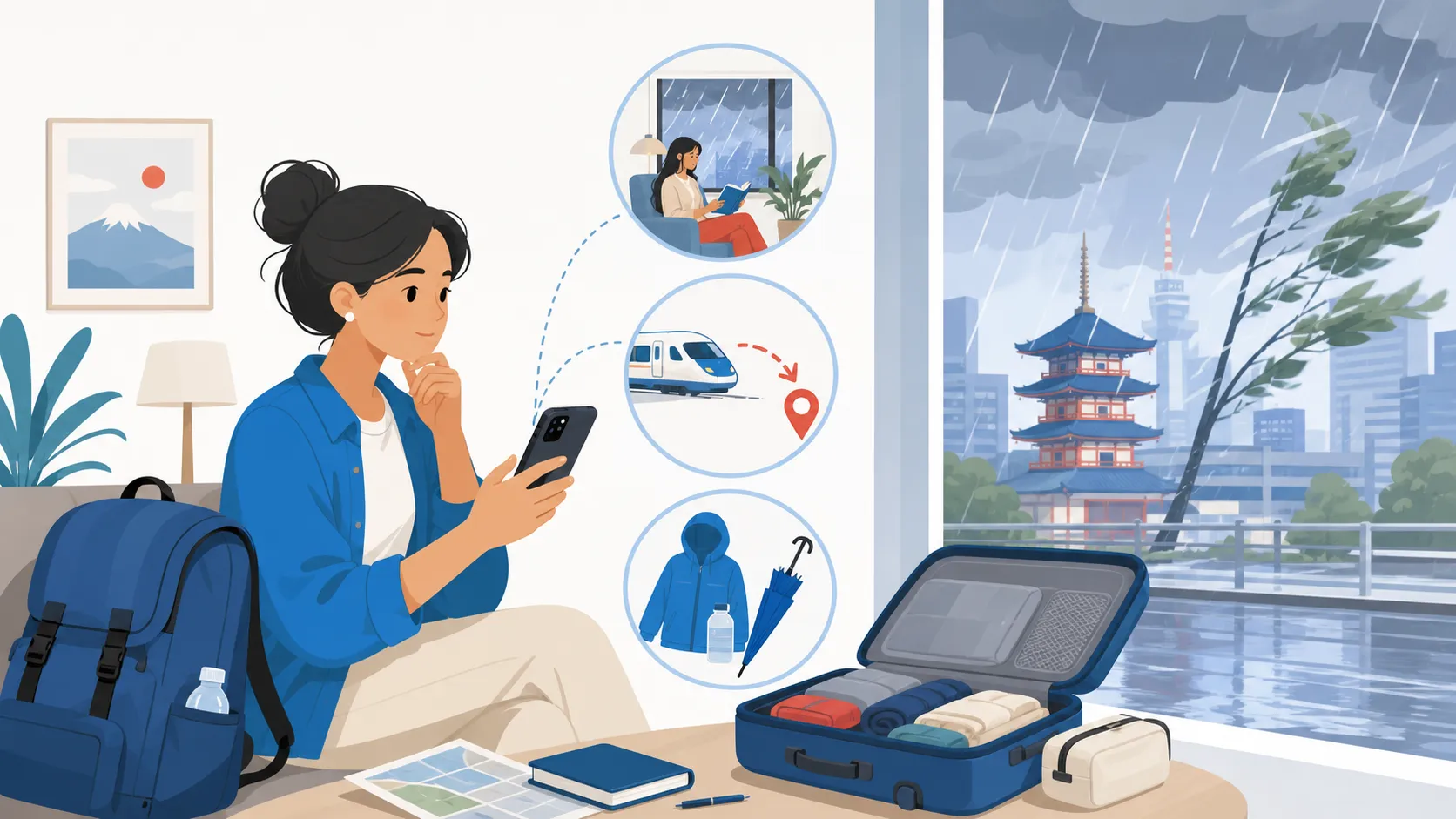
 A typhoon, heat warning or heavy rain is forecast — should I change my Japan plans?
Short answer: Check the Japan Meteorological Agency (JMA) warning level for your area and dates before deciding. A typhoon “warning” or a Heat Stroke Alert usually means real disruption — Shinkansen suspensions, flight cancellations, or genuine health risk — and is worth rearranging around. A typhoon “advisory” or ordinary hot weather usually just means adjusting timing, not canceling.
If this is happening now
- Check JMA’s warning map for your specific prefecture and dates (typhoon path/warnings, or the Heat Stroke Alert) rather than relying on general news headlines.
- Check your specific transport provider’s status page (JR line status, your airline’s flight status page) — Shinkansen and flights are suspended independently of each other and often before the storm actually arrives locally.
- Decide based on severity: reschedule outdoor/coastal plans and travel days around confirmed suspensions; for heat, simply shift outdoor activities to early morning/evening rather than canceling the trip.
Who this applies to
Any nationality, any purpose of visit, using Shinkansen, domestic/international flights, or planning outdoor activities in Japan during typhoon season (roughly June–October) or summer heat season (roughly July–September).
Decision table
| Situation | Status | What to do |
|---|---|---|
| Typhoon advisory or distant storm, several days out | Normal | Keep watching forecasts; no action needed yet |
| Heat Stroke Alert issued for your area, WBGT high | Needs action | Move outdoor plans to early morning/evening, stay hydrated, use air conditioning, keep an indoor backup |
| Typhoon warning issued, or JR/airline has posted suspensions for your travel day | Needs action | Check rebooking/refund options now, before the day of travel; avoid coastal or mountain excursions |
| Heavy rain warning with flood/landslide risk in your area | Needs action | Avoid rivers, coastal areas, and mountain trails; follow local evacuation guidance if issued |
| Extreme heat with symptoms (dizziness, nausea, confusion) in yourself or a companion | Emergency | Move to shade/AC, cool the body, hydrate, and call 119 if symptoms are severe |
Japan-specific procedure
Reading JMA warnings. JMA publishes real-time typhoon tracks and a tiered system of advisories and warnings (and in severe cases, “emergency warnings”) for wind, rain, flooding, and high waves, broken down by prefecture. For heat, the Ministry of the Environment and JMA jointly issue a Heat Stroke Alert when the WBGT (Wet Bulb Globe Temperature) index is expected to reach 33 or higher; alerts are announced the evening before and again the morning of. In 2026 Japan also introduced the term “kokushobi” for exceptionally severe heat days reaching 40°C. Check JMA’s English-language warning map directly for your specific location rather than relying on general “typhoon season” assumptions.
Transport disruption patterns. During significant typhoons, JR companies (JR East, JR Central, JR West, etc.) commonly announce Shinkansen suspensions or reduced service in advance — sometimes the day before — for affected lines, and airlines cancel large numbers of domestic flights when a storm is expected to hit a major hub. If your reserved Shinkansen is officially canceled due to weather, JR generally provides a full refund without penalty, claimable at any major JR station within about a year. For flights, contact your airline directly for rebooking or refund options — most carriers will assist with rebooking and, if you’re stranded overnight, some form of care (meals, accommodation) depending on the circumstances.
Simple decision framework:
-
Advisory-level warning, light rain, or normal seasonal heat → keep your itinerary, just adjust daily timing.
-
Warning-level typhoon alert or confirmed Shinkansen/flight suspension on your travel day → actively rebook that leg or swap the order of destinations if the storm is regional; don’t wait until the last minute since queues at ticket counters get long.
-
Heat Stroke Alert or emergency warning of any kind → treat it as a health and safety instruction, not a scheduling inconvenience: skip strenuous outdoor plans (hiking, long temple walks at midday) regardless of how the rest of your itinerary looks.
-
JMA, weather warning/advisory portal (English): https://www.data.jma.go.jp/multi/warn/index.html?lang=en
-
Ministry of the Environment, Heat Illness Prevention/Heat Stroke Alert: https://www.wbgt.env.go.jp/en/
-
JMA, Heat Stroke Alert map: https://www.jma.go.jp/bosai/map.html#7/43.402/143.082/&contents=heat&lang=en
What this is not
This is not the same as an earthquake or tsunami response, which requires immediate physical action (drop-cover-hold, evacuate) regardless of forecasts — see the companion article on earthquake/tsunami first actions. Typhoons, heat, and heavy rain are forecastable days in advance, so the right response here is planning and rebooking, not split-second action — except in the specific case of heat-illness symptoms or sudden flash flooding, which do need immediate response.
Recovery after a mistake
If you already booked non-refundable activities during a day that later gets a typhoon warning, contact the operator directly — many Japanese tour operators and even some hotels have weather-related flexible cancellation policies during named storms, especially if public transport is officially suspended. If you traveled anyway and got stuck due to a Shinkansen suspension, go to a JR ticket office (Midori-no-Madoguchi) as soon as possible with your ticket for rebooking or refund rather than waiting at the platform.
Questions travelers ask
How far in advance do Shinkansen suspensions get announced? Often the day before for a well-tracked typhoon, sometimes with only a few hours’ notice for a fast-developing storm — check your specific line’s status page each morning during typhoon season.
Is it safe to fly during typhoon season generally? Yes, most days are unaffected; disruption clusters around the 1–2 days a storm is closest to a given region, so check dates specifically rather than avoiding the whole season.
What does a Heat Stroke Alert actually mean I should do differently? Reduce outdoor exertion, especially midday, drink fluids before you’re thirsty, and treat air-conditioned indoor time as part of the plan, not a fallback.
Can I get travel insurance to cover a canceled trip due to a typhoon? Many travel insurance policies include weather-related trip interruption/cancellation coverage, but terms vary widely — check your specific policy before assuming it’s covered.
If this actually happens to you (Travel AI Rescue)
Deciding whether a forecast actually threatens your specific day and route — not just “a typhoon is somewhere near Japan” — is a fiddly, source-juggling task, and that’s the kind of real-time trip-logistics question Travel AI Rescue helps sort through quickly.
| Free AI (ChatGPT, Gemini, etc.) | Travel AI Rescue |
|---|---|
| Can’t open it with no signal | A SIM problem is exactly when you have no signal — offline setup steps and emergency cards still work |
| You have to explain your situation every time | Already knows your plan and destination from your order — no re-explaining |
| Wrong answers in an emergency can be dangerous | SIM check uses a pre-approved decision tree; emergency numbers, embassies, and clinics come from official sources — never invented |
| No help before or after the trip | Pre-trip vault through automatic post-incident document generation (police report draft, insurance claim summary), end to end |
Included with every eSIM as standard ($7.40 if bought on its own). AI-drafted guidance, not a final medical/legal/immigration determination — contact local police, ambulance, or your embassy first in a real emergency.
Sources (checked 2026-07-20)
- Japan Meteorological Agency, weather warning/advisory: https://www.data.jma.go.jp/multi/warn/index.html?lang=en
- Ministry of the Environment, Heat Illness Prevention Information: https://www.wbgt.env.go.jp/en/
- Japan Meteorological Agency, Heat Stroke Alert map: https://www.jma.go.jp/bosai/map.html
Update trigger: Re-check each typhoon season (June–October) and summer heat season, or after any major named storm affecting Japan.
Related pages: Health & Emergencies hub, Earthquake or Tsunami During a Japan Trip: First Actions, Seeing a Doctor in Japan: Insurance, Payment and Language Help
🆘 Don't just read it — be ready for it.
Travel AI Rescue is an emergency travel AI for theft, illness, SIM trouble & more — auto-drafted police reports, local-language cards and an on-device valuables vault. Bundle it with your eSIM.
See how Travel AI Rescue works →