
 🆘 Worried about trouble abroad? Travel AI Rescue helps you on the spot — theft, illness, a lost passport, scams & more. See how it works →
 Japan and Hong Kong Trip: Entry, Transit and Payment Setup
Meta description: Combining Japan and Hong Kong on one trip? Here’s the transit-status rules, Octopus vs. IC card handoff, and payment fallback between legs.
Who this is for, and a passport disclaimer
This guide is written for a general international traveler flying between Japan and Hong Kong on the same trip—commonly Tokyo/Osaka to Hong Kong International Airport, or the reverse. Entry and transit rules for Hong Kong vary more sharply by nationality than almost any other stop in this pilot set: some passport holders get up to 180 days visa-free, others get as little as 7, and some nationalities need a visa even to transit airside without clearing immigration. None of the process below substitutes for checking your own nationality’s status with Hong Kong’s Immigration Department and Japan’s Ministry of Foreign Affairs before you book.
Entry permission vs. arrival form for both countries
Japan: for visa-exempt nationalities, permission to enter is granted on arrival. The separate arrival/customs declaration can be pre-filed through Visit Japan Web, producing a QR code that speeds up the immigration and customs process at the airport.
Hong Kong: Hong Kong doesn’t use a single universal arrival-card system the way Japan, Taiwan, or Thailand do. What you need depends on your status:
- Visa-free visit: most Western and many Asia-Pacific passport holders (commonly 7–180 days depending on nationality) enter visa-free with no arrival card required in the way Southeast Asian arrival-card systems work; you’ll typically use an e-Channel or standard immigration counter.
- Pre-Arrival Registration (PAR): a separate, free, visa-exemption mechanism required for a specific set of nationalities (which has included Indian passport holders, among others) who would otherwise need a visa—PAR is valid for six months, allows multiple entries, and grants visa-free stays of up to 14 days per visit. It is not required for passport holders (such as US, UK, Australian, or Singapore nationals) who already qualify for ordinary visa-free entry.
- Visa required: applies to nationalities not covered by either of the above; must be arranged before travel.
Because your status depends entirely on nationality, confirm which of these three categories applies to you specifically before assuming you can simply show up.
Filing order and windows
- Visit Japan Web (if Japan is your first leg) — no fixed earliest date; complete any time before arrival, ideally a few days ahead.
- Hong Kong PAR (only if your nationality requires it) — apply online before departure; approval isn’t instant, so allow a reasonable buffer (days, not hours) before your Hong Kong arrival.
- If your nationality needs a full Hong Kong visa, that application timeline is longer still (often weeks)—start it well before booking a tight connection through Hong Kong.
If your route is Hong Kong-first-then-Japan, complete the Hong Kong-side requirement (PAR or visa, if applicable to you) before that leg, then Visit Japan Web before your Japan arrival.
Through-ticket vs. separate-ticket baggage, and the transit distinction
This route has an extra wrinkle: whether you’re formally transiting Hong Kong (staying airside, not clearing immigration) or entering it (leaving the airport, even briefly) changes both your document requirements and your baggage handling.
Airside transit, through-ticket: if you have a single through-ticket and remain in the airport’s transit area, many nationalities don’t need a visa or PAR at all, and checked baggage is normally tagged straight through to your final destination without reclaim.
Formal entry, or separate tickets: if you clear Hong Kong immigration—either because you’re staying in the city or because your Japan and Hong Kong flights are on two unrelated tickets requiring you to collect and recheck your bag—you must meet the visa-free/PAR/visa requirement above, collect your checked bag, clear customs, and check in again for your onward flight. This can take 3–4 hours at Hong Kong International Airport during busy periods, so don’t book a short layover assuming airside-transit speed if your itinerary actually requires immigration clearance.
If your Japan and Hong Kong flights are separate tickets and you miss the connection, there’s no airline obligation to rebook you or protect your bag, since the two segments aren’t linked in one reservation—budget slack time or separate trip-delay coverage accordingly.
Power banks and dangerous goods by operating airline
The standard international lithium-battery rules apply on both legs: carry-on only, roughly 100Wh unrestricted in personal quantity, 100–160Wh needs airline approval (commonly capped at two spares), and above 160Wh is barred from passenger aircraft.
Hong Kong International Airport and Japanese airports both enforce baggage screening for these rules, but the operating carrier’s own policy is what actually sets your personal limit—full-service carriers based in Hong Kong or Japan, and the budget carriers that also fly this route, don’t all apply identical caps on power bank count or in-flight charging. If your outbound and return flights are on different carriers (a common pattern on this route, since several low-cost airlines compete on Japan–Hong Kong), check each one’s dangerous-goods page separately rather than assuming the same allowance both ways.
Payment, transit card, eSIM and 2FA changeover
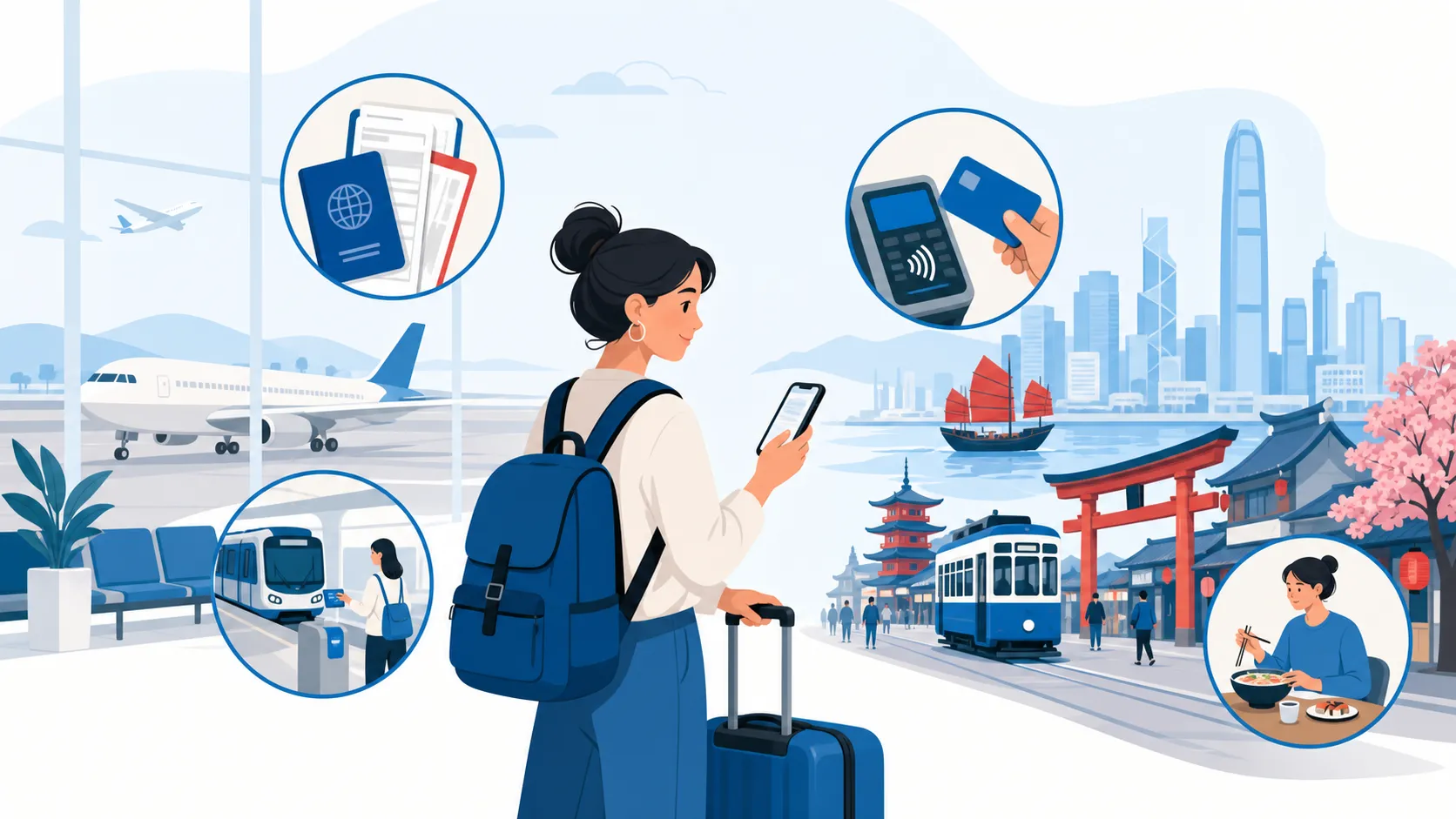
Japan’s IC cards (Suica, Pasmo, ICOCA) and Hong Kong’s Octopus card are entirely separate systems—Octopus doesn’t work on Japanese transit gates and vice versa. Octopus is also more broadly usable for retail and convenience-store payments in Hong Kong than Japan’s IC cards typically are for equivalent purchases in Japan, so budget a few minutes at the airport to pick one up (or its mobile-wallet equivalent) on arrival.
Contactless card and mobile payment acceptance is strong in both cities, and Hong Kong in particular is very card- and Octopus-friendly with less cash dependency than many other Asia-Pacific destinations—still, carry a backup payment method for each leg in case one network has an outage.
A Japan-only eSIM or physical SIM stops working the moment you land in Hong Kong. Set up the changeover before you fly: install a Hong Kong-specific eSIM (or a regional plan spanning both) using Wi-Fi before or right after landing, since you won’t have Japan-SIM data in Hong Kong. For two-factor authentication, favor an app-based authenticator over SMS codes tied to your home number—switching SIMs mid-trip is exactly when an SMS-based 2FA code can fail to arrive, right when you might need to access a bank account or airline booking to fix a problem.
Medication and prohibited-item differences
Japan restricts several medications that are legal elsewhere, including some stimulant-containing cold and allergy products and certain prescription stimulants, some requiring an import certificate (Yakkan Shoumei) or banned outright. Hong Kong maintains its own dangerous-drugs ordinance covering narcotics, certain psychotropic substances, and specific prescription medications, with documentation required for personal-use quantities of controlled substances—Hong Kong’s list of restricted compounds doesn’t map one-to-one onto Japan’s.
Check both countries’ current restricted-medication lists for anything containing pseudoephedrine, codeine, or stimulant compounds before packing—clearing one country’s customs with a medication doesn’t guarantee the other country will treat it the same way.
Insurance, onward tickets, and emergency contacts for both legs
Confirm your travel insurance policy’s coverage territory explicitly names both Japan and Hong Kong—broad “Asia” policies sometimes exclude Hong Kong or treat it separately from mainland China coverage, so read the country list rather than assuming.
Both Japan and Hong Kong immigration can ask visa-exempt or PAR-holding arrivals for proof of onward or return travel, so keep that itinerary accessible for either leg.
Emergency numbers: in Japan, dial 110 for police and 119 for fire/ambulance. In Hong Kong, dial 999 for police, fire, and ambulance (a single unified emergency number). Save both, along with your home country’s consular contact for Tokyo (or your Japan port of entry) and for Hong Kong, before you travel.
Official sources (checked on 2026-07-20)
| Topic | Country/Territory | Source | Checked on |
|---|---|---|---|
| Visit Japan Web (arrival/customs) | Japan | Digital Agency, Visit Japan Web official site | 2026-07-20 |
| Visa exemption / immigration | Japan | Ministry of Foreign Affairs of Japan | 2026-07-20 |
| Visa-free entry, PAR, transit rules | Hong Kong | Immigration Department, Hong Kong SAR Government | 2026-07-20 |
| Airport transit guidance | Hong Kong | Hong Kong International Airport Authority | 2026-07-20 |
If this actually happens to you (Travel AI Rescue)
A tight Hong Kong connection you’re not sure counts as “transit” or “entry,” or a card that stopped working between legs, is exactly the kind of two-country snag Travel AI Rescue is built to walk you through.
| Free AI (ChatGPT, Gemini, etc.) | Travel AI Rescue |
|---|---|
| Can’t open it with no signal | A SIM problem is exactly when you have no signal — offline setup steps and emergency cards still work |
| You have to explain your situation every time | Already knows your plan and destination from your order — no re-explaining |
| Wrong answers in an emergency can be dangerous | SIM check uses a pre-approved decision tree; emergency numbers, embassies, and clinics come from official sources — never invented |
| No help before or after the trip | Pre-trip vault through automatic post-incident document generation (police report draft, insurance claim summary), end to end |
Included with every eSIM as standard ($7.40 if bought on its own). AI-drafted guidance, not a final medical/legal/immigration determination — contact local police, ambulance, or your embassy first in a real emergency.
Related pages
- Japan + Multi-Country hub — see the other four pair guides in this pilot set
- Visit Japan Web setup guide (single-country Japan article) — for a step-by-step walkthrough of the arrival QR code
Last updated: 2026-07-20 (first publication)
🆘 Don't just read it — be ready for it.
Travel AI Rescue is an emergency travel AI for theft, illness, SIM trouble & more — auto-drafted police reports, local-language cards and an on-device valuables vault. Bundle it with your eSIM.
See how Travel AI Rescue works →