
 🆘 Worried about trouble abroad? Travel AI Rescue helps you on the spot — theft, illness, a lost passport, scams & more. See how it works →
 Japan and Taiwan Trip: Visit Japan Web, TWAC and Typhoon Planning
Meta description: Combining Japan and Taiwan on one trip? Here’s the TWAC filing window, baggage rules, and how to plan around shared typhoon season.
Who this is for, and a passport disclaimer
This guide is written for a general international traveler flying between Japan and Taiwan on the same trip—most commonly Tokyo/Osaka/Naha to Taipei/Kaohsiung, or the reverse. It assumes visa-exempt travel status on both sides, which depends entirely on your passport. Taiwan and Japan each maintain their own lists of visa-exempt nationalities and permitted stay lengths (commonly up to 90 days for many passports, but not universal); check your own nationality against both countries’ current lists before assuming any of the process below applies to you.
Entry permission vs. arrival form for both countries
Japan: for visa-exempt nationalities, entry permission is granted on arrival (a stamp, not a pre-approved authorization). The separate arrival/customs form can be filed ahead of time through Visit Japan Web, the Digital Agency’s official pre-registration service, which produces a QR code for faster immigration and customs processing.
Taiwan: for visa-exempt nationalities, entry permission likewise comes from Taiwan’s own visa-waiver program (again, nationality-dependent, generally allowing a set number of visa-exempt days). Separately, as of 2026 Taiwan requires most visa-exempt and visitor-visa foreign travelers to complete the TWAC (Taiwan Arrival Card) online before arrival. TWAC is Taiwan’s equivalent of an arrival/customs declaration, not a visa or entry authorization—it doesn’t grant permission to enter, it’s the digital form that replaced the old paper arrival card. It is completely free. Holders of an Alien Resident Certificate, a resident visa, or a diplomatic ID are exempt from TWAC.
Note that TWAC requires you to already have an onward/return flight booked out of Taiwan in order to complete the form, so book your outbound leg before you try to file it.
Filing order and windows
- Visit Japan Web (if arriving in Japan first) — no strict earliest window; complete any time before your Japan arrival, ideally a few days ahead so the QR code is ready on your phone.
- TWAC (Taiwan Arrival Card) — as of 2026-07-15, TWAC can be filed within a 7-day window before arrival in Taiwan (this window was extended from an earlier 3-day limit, so if you’ve traveled to Taiwan before under the old rule, note it’s now longer). File it once your Taiwan arrival date and accommodation address are confirmed, ideally 2–7 days out—not too early, since some fields may need to match your finalized itinerary.
If your route is Taiwan-first-then-Japan, complete TWAC before departure for the Taiwan leg, then Visit Japan Web before your Japan arrival on the second leg.
Through-ticket vs. separate-ticket baggage and missed connections
On a through-ticket covering both the Japan and Taiwan segments (single booking, interline or codeshare), checked baggage is normally tagged to your final destination and you won’t need to reclaim it at the connecting airport, barring a terminal change that requires a security recheck. The operating/marketing carrier is responsible for rebooking and baggage handling if a covered connection is missed due to a delay on their side.
On separate tickets (for example, a low-cost carrier into Naha and an unrelated low-cost carrier onward to Taipei), your bag is checked only to the first arrival airport. You must collect it, go through Japanese customs, and check in fresh for the Taiwan leg—there’s no automatic rebooking or bag protection if you miss the second flight, and the loss is yours to absorb unless you bought separate trip-delay insurance.
This distinction matters more than usual on this route because Japan–Taiwan connections are frequently flown by regional low-cost carriers that don’t interline with each other. Confirm before booking whether your itinerary is a true through-ticket or two independent bookings.
Power banks and dangerous goods by operating airline
The baseline international rule applies on both sides of this route: lithium batteries and power banks must be in carry-on baggage, not checked, with capacity tiers around 100Wh (generally unrestricted in reasonable personal quantity), 100–160Wh (requires airline approval, typically capped at two spare units), and above 160Wh (prohibited on passenger flights).
Where this route gets tricky is that Japan–Taiwan is heavily served by budget carriers, and low-cost airlines on both the Japanese and Taiwanese side have been known to apply stricter limits than full-service carriers—some cap total power bank count per passenger lower than the general 100–160Wh allowance, or restrict in-flight use of power banks to charge devices at your seat. If your outbound flight is on one budget carrier and your return or Taiwan-onward leg is on a different one, check each airline’s dangerous-goods page separately; don’t assume the airline that let you carry two power banks outbound will apply the same limit inbound.
Payment, transit card, eSIM and 2FA changeover
Japan’s IC cards (Suica, Pasmo, ICOCA) and Taiwan’s EasyCard (and the similar iPASS) are separate systems that don’t work on each other’s transit gates—budget time and a small amount of local currency to get a fresh card (or its mobile-wallet version) when you land in each country.
Contactless and mobile payment acceptance is generally strong in both Tokyo/Osaka and Taipei/Kaohsiung, but smaller vendors and night markets in Taiwan lean more heavily on cash than equivalent venues in Japan—carry some New Taiwan Dollars for the Taiwan leg even if you went card-only in Japan.
A Japan-only eSIM or physical SIM will stop functioning as soon as you land in Taiwan. Set up your eSIM changeover in advance: install a Taiwan-specific eSIM (or activate a regional plan that covers both countries) before you land, using airport or hotel Wi-Fi, since you won’t have Japan-SIM data once you’re in Taiwan. For two-factor authentication, prefer an app-based authenticator over SMS-based 2FA tied to your home number—SMS delivery reliability can dip when you’re on a fresh local SIM in a new country, right when you might need to log into a bank or airline account to fix a booking problem.
Medication and prohibited-item differences
Japan restricts a number of medications that are freely available elsewhere, including some stimulant-containing cold and allergy medicines and certain prescription stimulants, some of which require an import certificate (Yakkan Shoumei) or are banned outright. Taiwan’s controlled-substance list differs in its specifics—narcotics and certain psychotropic medications require documentation, and quantities matter—but the common OTC cold and allergy medicines that trip up travelers in Japan are generally not restricted the same way in Taiwan.
Don’t assume a medication that’s fine in Taiwan will also be fine in Japan (or the reverse): check both countries’ current restricted-medication lists for anything containing pseudoephedrine, codeine, or stimulant compounds before you pack for a Japan–Taiwan trip.
Typhoon-season planning across both legs
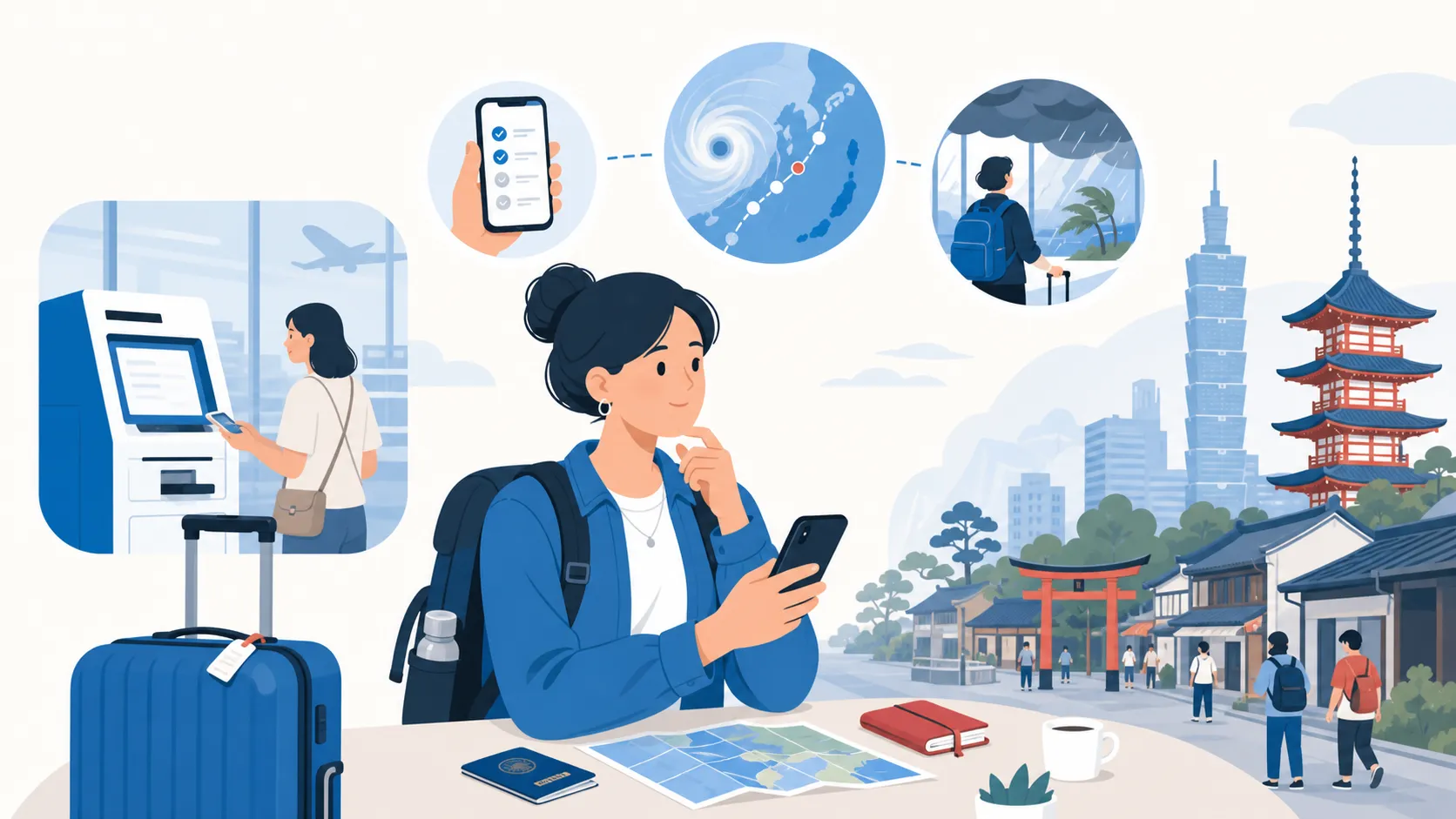
Japan and Taiwan sit in the same broad typhoon corridor, and the same storm system can disrupt both legs of a single trip within days of each other—this is the practical risk unique to this pairing. If you’re traveling roughly July through October, build slack into your itinerary: avoid same-day connections between the two countries during this window, check both Japan Meteorological Agency and Taiwan Central Weather Administration forecasts a few days out, and know your airline’s typhoon-related rebooking/waiver policy before you fly, since many carriers issue fee waivers only once a storm warning is officially posted. Trip insurance that explicitly covers “natural disaster” flight disruption is worth prioritizing on this route specifically, since a delay on one leg can cascade into the other.
Insurance, onward tickets, and emergency contacts for both legs
Confirm your travel insurance policy’s coverage territory explicitly includes both Japan and Taiwan—don’t assume a general “Asia” policy covers both without checking the country list in the policy document. Both Japan and Taiwan can request proof of onward or return travel from visa-exempt arrivals (and Taiwan’s TWAC process effectively requires it before you can even file the form), so keep that itinerary accessible on both legs.
Emergency numbers: in Japan, dial 110 for police and 119 for fire/ambulance. In Taiwan, dial 110 for police and 119 for fire/ambulance—conveniently the same digits in both countries, though the response language may default to Japanese or Mandarin respectively, so know where your embassy’s emergency contact is in both Tokyo (or your Japan port of entry) and Taipei before you travel.
Official sources (checked on 2026-07-20)
| Topic | Country | Source | Checked on |
|---|---|---|---|
| Visit Japan Web (arrival/customs) | Japan | Digital Agency, Visit Japan Web official site | 2026-07-20 |
| Visa exemption / immigration | Japan | Ministry of Foreign Affairs of Japan | 2026-07-20 |
| TWAC (Taiwan Arrival Card), 7-day window | Taiwan | National Immigration Agency, R.O.C. / TWAC official portal | 2026-07-20 |
| Visa-exemption program | Taiwan | Bureau of Consular Affairs, Ministry of Foreign Affairs, Taiwan | 2026-07-20 |
If this actually happens to you (Travel AI Rescue)
A typhoon reroute or a Taiwan connection you weren’t sure how to rebook is exactly the kind of two-country snag Travel AI Rescue is built to walk you through.
| Free AI (ChatGPT, Gemini, etc.) | Travel AI Rescue |
|---|---|
| Can’t open it with no signal | A SIM problem is exactly when you have no signal — offline setup steps and emergency cards still work |
| You have to explain your situation every time | Already knows your plan and destination from your order — no re-explaining |
| Wrong answers in an emergency can be dangerous | SIM check uses a pre-approved decision tree; emergency numbers, embassies, and clinics come from official sources — never invented |
| No help before or after the trip | Pre-trip vault through automatic post-incident document generation (police report draft, insurance claim summary), end to end |
Included with every eSIM as standard ($7.40 if bought on its own). AI-drafted guidance, not a final medical/legal/immigration determination — contact local police, ambulance, or your embassy first in a real emergency.
Related pages
- Japan + Multi-Country hub — see the other four pair guides in this pilot set
- Visit Japan Web setup guide (single-country Japan article) — for a step-by-step walkthrough of the arrival QR code
Last updated: 2026-07-20 (first publication)
🆘 Don't just read it — be ready for it.
Travel AI Rescue is an emergency travel AI for theft, illness, SIM trouble & more — auto-drafted police reports, local-language cards and an on-device valuables vault. Bundle it with your eSIM.
See how Travel AI Rescue works →