
 🆘 Worried about trouble abroad? Travel AI Rescue helps you on the spot — theft, illness, a lost passport, scams & more. See how it works →
 Checked against Japan’s Road Traffic Act (via the Japanese Law Translation database), the Tokyo Metropolitan Police Department’s guidance for foreign licence holders, and JAF’s official visitor-procedures pages on 11 September 2026. Rental company insurance terms vary, so confirm the fine print with your rental counter before you drive off.
Driving in Japan is genuinely easy for visitors — roads are well marked, GPS navigation works reliably, and the vast majority of rental periods end with the car handed back without incident. If something does go wrong, though, Japan handles it differently from most countries, in two ways that rarely come up until they matter: which licences are actually valid, and what you’re legally required to do the moment metal touches metal, even if nobody’s hurt and the damage looks trivial.
Even a parking-lot scrape has to be reported to police
Under Article 72 of the Road Traffic Act, anyone involved in a traffic accident in Japan has three obligations: help anyone injured, keep the road safe from further danger, and report the accident to the police. That third obligation applies no matter how small the damage is and no matter who’s at fault — there’s no threshold for “too minor to bother.” Skipping it can be treated the same way as a hit-and-run, and the penalty on the books is imprisonment of up to three months or a fine above ¥50,000. It applies to rental car drivers exactly as it applies to residents; nothing about being a tourist exempts you.
In practice this is simple to satisfy: call 110 for police, or 119 if anyone is hurt, and wait at the scene until an officer arrives or tells you what to do next. You don’t need to resolve fault or negotiate anything with the other driver first — that call is the one non-negotiable step.
No police report means no accident certificate — and no accident certificate means no payout
Here’s the part that catches visitors off guard later, once they’re back home and filing a claim. Japan’s rental insurance and travel insurance claims are both built around a single document: the Traffic Accident Certificate (交通事故証明書), issued by the local Safe Driving Center, and it can only be issued if the accident was reported to police at the time. Skip the call, and there’s no certificate to request afterward — no matter how clear the damage is or how cooperative the other driver was. Insurers and rental companies aren’t being difficult by asking for it; without an official record, they have no way to distinguish your claim from pre-existing damage.
The “Non-Operation Charge” isn’t insurance, and most basic coverage doesn’t touch it
Most Japanese rental agreements bundle in a Collision Damage Waiver (CDW), which covers your deductible if the car is damaged. What it typically doesn’t cover is the Non-Operation Charge (NOC) — a separate, fixed fee the rental company charges to cover the income it loses while the car is off the road for repairs. It’s commonly around ¥20,000 if the car is still drivable and ¥50,000 if it needs to be towed, and it applies even for a small scratch or a chipped windshield, regardless of who caused it. CDW alone doesn’t reduce it to zero; only a higher-tier plan — often sold as an “NOC waiver” or “full cover” option for a small daily add-on — does that. If avoiding a surprise bill matters to you, it’s worth asking specifically about NOC coverage when you book, not just whether “insurance” is included.
Six countries and one territory can’t use an International Driving Permit here at all
Japan only recognises International Driving Permits issued under the 1949 Geneva Convention — an IDP based on the newer 1969 Vienna Convention isn’t valid, even from a country most people assume is covered. More importantly, licence holders from France, Germany, Switzerland, Belgium, Monaco, and Taiwan can’t use an IDP in Japan under any circumstances, Geneva-format or otherwise. Instead, Japan recognises a certified Japanese translation of the driver’s home licence, issued by JAF or the relevant embassy, as the valid substitute. Renting a car with an IDP from one of these six is the single most common reason a rental counter turns a visitor away on the spot — arrange the translation before you travel if this applies to you.
For everyone else, the IDP itself has a shelf life worth checking: it’s valid for one year from its date of issue, but you can only drive on it for one year from the date you entered Japan — whichever limit comes first. Getting a fresh IDP right before a return trip doesn’t reset the clock if you’re re-entering Japan less than three months after a previous stay.
What to have ready at the rental counter and at the scene
Bring your passport, your home driver’s licence, and either your Geneva-format IDP or your certified Japanese translation — rental counters check these against the vehicle contract, not just at pickup. If an accident happens, the rental company’s own emergency line (printed on the contract) is worth calling right after police, since they’ll want to arrange a replacement vehicle and start their own paperwork while the officer is still on scene.
How Travel AI Rescue helps
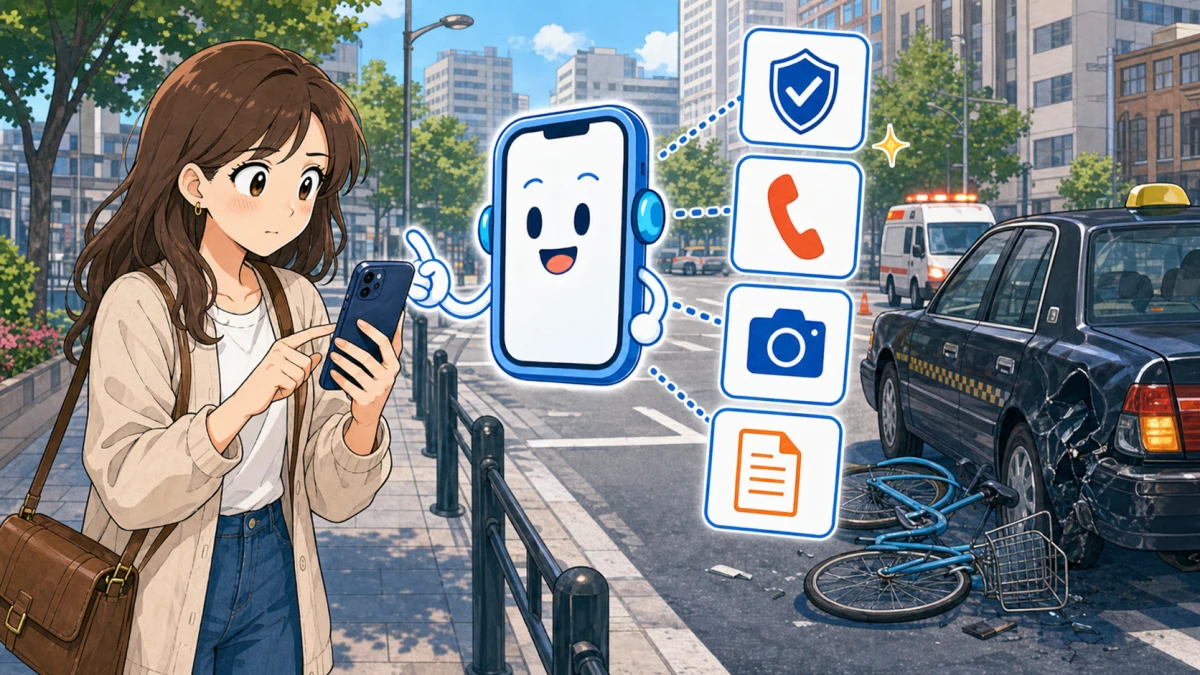
Travel AI Rescue keeps Japan’s police and ambulance numbers one tap away, with the country code already attached, so you’re not hunting for 110 or 119 while standing next to a damaged bumper. It can display a Japanese-language card explaining exactly what happened — “I was in a car accident,” for instance — so the responding officer understands you immediately even without a shared language. And above all, it helps assemble a clear summary of the accident and a report draft you can hand to your rental company or insurer, while keeping your licence, IDP, and rental contract details stored and readable on the device even with no signal. It works differently from a staffed help desk, and it’s with you around the clock — a bridge that gets you to the right window with the right information already prepared. (Whether a claim is approved is a decision made by your rental company and insurer, not by Travel AI Rescue.)
Sources
- Japanese Law Translation, “Road Traffic Act,” Article 72. https://www.japaneselawtranslation.go.jp/en/laws/view/2962/en (accessed 11 September 2026).
- Tokyo Metropolitan Police Department, “Valid International Driving Permit in Japan.” https://www.keishicho.metro.tokyo.lg.jp/multilingual/english/traffic_safety/drivers_licenses/index.files/kokusaimenkyo_english.pdf (accessed 11 September 2026).
- JAF (Japan Automobile Federation), “運転免許証の翻訳文” (Translation of driver’s licences for Switzerland, Germany, France, Belgium, Monaco, and Taiwan). https://jaf.or.jp/common/visitor-procedures (accessed 11 September 2026).
🆘 Don't just read it — be ready for it.
Travel AI Rescue is an emergency travel AI for theft, illness, SIM trouble & more — auto-drafted police reports, local-language cards and an on-device valuables vault. Bundle it with your eSIM.
See how Travel AI Rescue works →